25 Highest Paying Jobs in 2026: Future Career Opportunities
BlogIntroduction: Planning Your Future Career Today
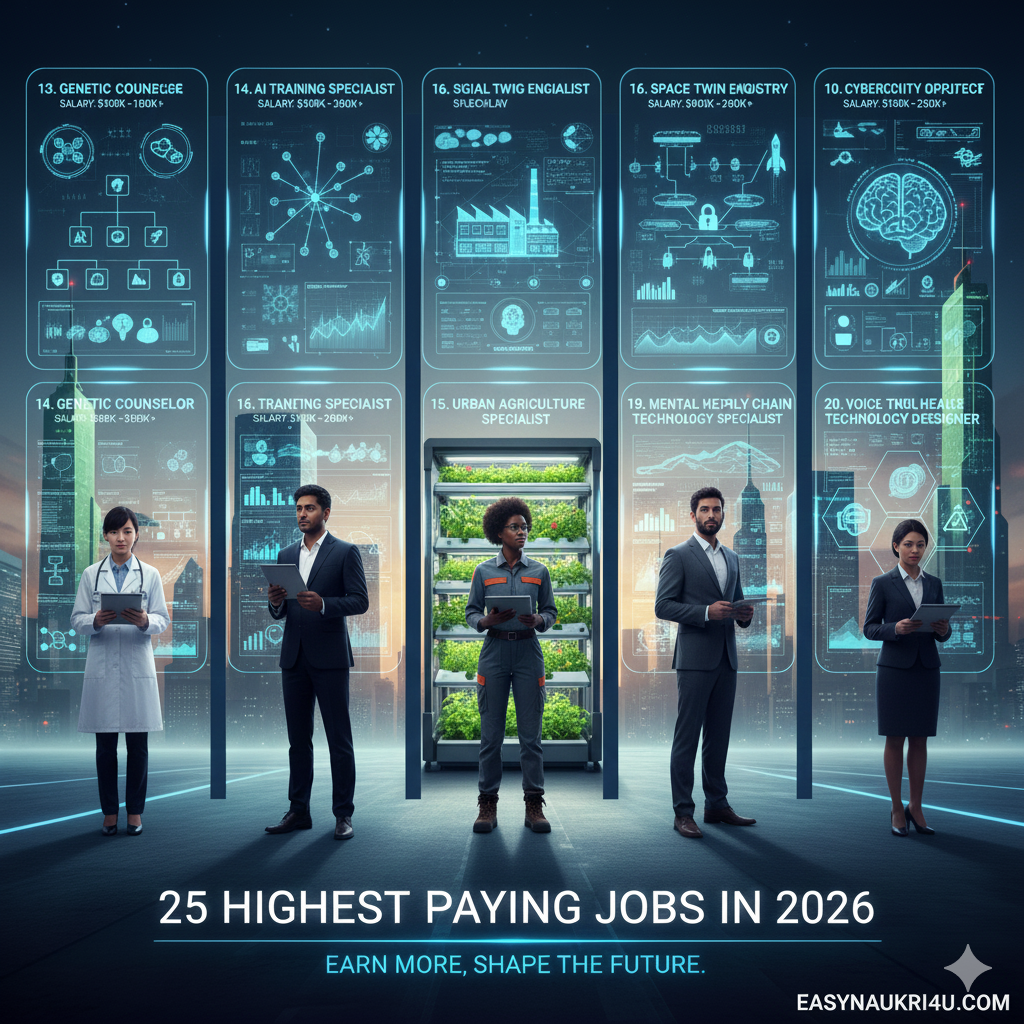
The professional landscape is evolving at an unprecedented pace, and understanding which jobs in 2026 will offer the best opportunities is crucial for anyone planning their career trajectory. Whether you’re a student choosing your field of study, a professional considering a career pivot, or someone entering the workforce, knowing which careers will thrive in the near future helps you make strategic decisions today that position you for success tomorrow.
visit our website – EasyNaukri4U – India’s Leading Government Job Portal
visit our resume builder – Government Jobs - EasyNaukri4U
“According to LinkedIn’s Global Talent Trends Report, recruiters spend an average of six to seven seconds reviewing each resume.”
The jobs in 2026 will be shaped by several powerful forces: artificial intelligence advancement, climate change urgency, demographic shifts, technological innovation, and changing work models. Many traditional roles are being transformed while entirely new career categories emerge. Understanding these trends and positioning yourself accordingly can mean the difference between struggling in a declining field and thriving in a growing, well-compensated profession.
This comprehensive guide explores twenty-five of the most promising jobs in 2026, examining expected salary ranges, required skills and qualifications, growth trajectories, and strategic steps you can take now to prepare for these opportunities. We’ll look beyond just technology roles to explore diverse career paths across healthcare, sustainability, creative industries, and business sectors that will offer exceptional opportunities in the coming years.
The beauty of planning for jobs in 2026 now is that you have time to acquire necessary skills, gain relevant experience, and position yourself strategically before competition intensifies. While some of these careers require extensive education, others can be accessed through bootcamps, certifications, or self-directed learning. The key is starting your preparation today rather than waiting until these opportunities are already highly competitive.
For career planning resources and job opportunities, visit: 👉 https://easynaukri4u.com/
Understanding the 2026 Job Market Landscape
Key Trends Shaping Future Employment
Several major trends will define jobs in 2026 and determine which careers offer the best opportunities. Artificial intelligence and automation will continue transforming work, eliminating some roles while creating new categories requiring human oversight, creativity, and ethical judgment. Climate change and sustainability initiatives will generate entirely new industries and career paths focused on environmental solutions and green technology.
The aging global population, particularly in developed nations, will drive massive demand for healthcare professionals, eldercare specialists, and health technology experts. Remote and hybrid work models will continue expanding, creating opportunities for professionals who can work effectively in distributed environments. Understanding these macro trends helps you identify which jobs in 2026 offer not just high current salaries but sustainable long-term career paths.
Skills That Will Define Success
Certain skills will be valuable across nearly all jobs in 2026, regardless of specific industry or role. Digital literacy and comfort with AI tools will be as fundamental as computer skills are today. Adaptability and continuous learning capabilities will be essential as roles evolve rapidly. Critical thinking and complex problem-solving—skills that AI struggles with—will command premium value.
Emotional intelligence, cross-cultural communication, and collaboration skills will differentiate successful professionals as automation handles routine tasks. Creativity and innovation capacity will be highly valued as organizations seek competitive advantages through novel solutions. Understanding these universal success factors helps you develop capabilities that ensure career resilience across multiple jobs in 2026.
25 Highest Paying Jobs in 2026

1. AI Ethics Officer
As artificial intelligence becomes embedded in critical decisions affecting society, AI ethics officers will be among the most important jobs in 2026. These professionals ensure AI systems operate fairly, transparently, and ethically, developing governance frameworks, auditing algorithms for bias, and guiding organizations through complex ethical dilemmas posed by AI deployment.
Expected Salary: $150,000 – $250,000+ annually
Required Skills: AI/ML understanding, ethics and philosophy, policy development, risk assessment, communication
Education Path: Computer science, philosophy, law, or ethics degrees; AI ethics certifications
Growth Outlook: Extremely high as regulations and public scrutiny increase
AI ethics represents emerging jobs in 2026 where early specialists can establish themselves as authorities before the field becomes saturated. The intersection of technical knowledge and ethical reasoning creates significant barriers to entry that support high compensation.
2. Quantum Computing Engineer
Quantum computing is transitioning from theoretical research to practical applications, creating specialized jobs in 2026 for engineers who can design, build, and optimize quantum systems. These professionals work on quantum algorithms, hardware development, and applications across cryptography, drug discovery, financial modeling, and optimization problems.
Expected Salary: $140,000 – $280,000+ annually
Required Skills: Quantum mechanics, advanced mathematics, programming, problem-solving, research abilities
Education Path: Advanced degrees in physics, computer science, or engineering; specialized quantum computing programs
Growth Outlook: Explosive growth as quantum technology matures
While highly specialized, quantum computing represents jobs in 2026 with exceptional earning potential for those willing to pursue advanced education in this cutting-edge field.
3. Personalized Medicine Specialist
Healthcare is moving toward treatments tailored to individual genetic profiles, creating jobs in 2026 for specialists who integrate genomic data, lifestyle factors, and medical history to design personalized treatment plans. These professionals combine medical knowledge with data science and genetics expertise.
Expected Salary: $180,000 – $300,000+ annually
Required Skills: Medical expertise, genomics, data analysis, patient communication, research interpretation
Education Path: Medical degree plus genomics/personalized medicine specialization
Growth Outlook: Very high as precision medicine becomes standard practice
Personalized medicine represents jobs in 2026 at the intersection of multiple high-value fields—healthcare, genetics, and data science—commanding premium compensation.
4. Climate Change Analyst
As climate challenges intensify, organizations need experts who can assess climate risks, develop adaptation strategies, and guide decision-making around environmental impacts. Climate change analysts are among the increasingly critical jobs in 2026, working across government, corporate, and nonprofit sectors.
Expected Salary: $90,000 – $160,000+ annually
Required Skills: Environmental science, data analysis, modeling, policy understanding, communication
Education Path: Environmental science, earth sciences, or related degrees; climate-focused certifications
Growth Outlook: Strong growth driven by regulatory requirements and climate urgency
Climate-focused careers represent jobs in 2026 where passion for environmental issues aligns with strong earning potential and job security in a field that will only grow more important.
5. Cybersecurity Architect
Cyber threats will continue evolving in sophistication, making cybersecurity architects among the most essential and highly compensated jobs in 2026. These professionals design comprehensive security frameworks, protect against advanced threats, ensure regulatory compliance, and respond to security incidents.
Expected Salary: $130,000 – $220,000+ annually
Required Skills: Security frameworks, threat intelligence, system architecture, risk management, emerging tech understanding
Education Path: Computer science or cybersecurity degrees; advanced certifications (CISSP, CISM)
Growth Outlook: Extremely high with persistent talent shortages
Cybersecurity represents jobs in 2026 with exceptional job security given that threats will always exist and evolve, requiring continuous human expertise.
For cybersecurity career resources, explore: 👉 https://easynaukri4u.com/
6. Virtual Reality Experience Designer
As VR technology matures and finds applications beyond gaming—in education, training, therapy, and remote collaboration—VR experience designers will be among the creative jobs in 2026 commanding strong salaries. These professionals create immersive experiences that are engaging, intuitive, and serve specific purposes.
Expected Salary: $95,000 – $170,000+ annually
Required Skills: 3D design, user experience, psychology, storytelling, technical VR platforms
Education Path: Design, computer science, or digital media degrees; VR-specific training
Growth Outlook: High as VR adoption accelerates across industries
VR design represents jobs in 2026 combining creativity with technical skills, appealing to those who want to shape how people interact with digital environments.
7. Blockchain Solutions Architect
Blockchain technology will expand beyond cryptocurrency into supply chain, healthcare, finance, and government applications, creating sophisticated jobs in 2026 for architects who can design and implement blockchain solutions. These professionals understand distributed systems, cryptography, and business applications.
Expected Salary: $120,000 – $200,000+ annually
Required Skills: Blockchain platforms, smart contracts, cryptography, system design, business analysis
Education Path: Computer science degrees; blockchain certifications; hands-on development experience
Growth Outlook: Strong as blockchain moves into mainstream business applications
Blockchain architecture represents jobs in 2026 where early expertise provides significant advantages before the talent market becomes saturated.
8. Robotics Engineer
Robotics will pervade manufacturing, healthcare, agriculture, logistics, and consumer applications, making robotics engineers among the most valuable jobs in 2026. These professionals design, build, program, and maintain robotic systems that automate complex tasks and work alongside humans.
Expected Salary: $100,000 – $180,000+ annually
Required Skills: Mechanical engineering, programming, AI/ML, sensors and controls, problem-solving
Education Path: Engineering degrees (mechanical, electrical, robotics); advanced degrees for research roles
Growth Outlook: Very high across multiple industries
Robotics represents jobs in 2026 with diverse applications, from industrial automation to surgical robots to autonomous vehicles, providing varied career paths.
9. Telemedicine Physician
Remote healthcare delivery has proven effective and convenient, ensuring telemedicine physicians remain among the important jobs in 2026. These doctors provide medical consultations, diagnoses, and treatment recommendations through digital platforms, expanding healthcare access while improving efficiency.
Expected Salary: $200,000 – $350,000+ annually
Required Skills: Medical expertise, digital communication, remote diagnosis, technology comfort, empathy
Education Path: Medical degree and licensing; telemedicine-specific training
Growth Outlook: Strong as remote healthcare becomes standard practice
Telemedicine represents jobs in 2026 offering physicians lifestyle flexibility while serving patients unable to access traditional healthcare easily.
10. Data Privacy Consultant
Growing concerns about data privacy and expanding regulations create high demand for privacy consultants among jobs in 2026. These professionals help organizations comply with privacy laws, implement data protection measures, conduct audits, and develop privacy-first strategies.
Expected Salary: $110,000 – $190,000+ annually
Required Skills: Privacy regulations, data governance, risk assessment, policy development, technology understanding
Education Path: Law, computer science, or information security degrees; privacy certifications (CIPP, CIPM)
Growth Outlook: Very high as privacy regulations expand globally
Data privacy represents jobs in 2026 at the intersection of legal, technical, and business domains, appealing to diverse professional backgrounds.
11. Renewable Energy Engineer
The transition to sustainable energy creates abundant jobs in 2026 for engineers who design, implement, and optimize renewable energy systems. These professionals work with solar, wind, hydroelectric, and emerging energy technologies to build sustainable power infrastructure.
Expected Salary: $85,000 – $150,000+ annually
Required Skills: Engineering principles, renewable technologies, project management, environmental regulations, innovation
Education Path: Engineering degrees (electrical, mechanical, environmental); renewable energy specializations
Growth Outlook: Excellent as renewable energy investment accelerates globally
Renewable energy represents jobs in 2026 where environmental impact aligns with strong career prospects in a rapidly growing sector.
12. Augmented Reality Developer
AR technology will integrate into daily life through smartphones, wearables, and specialized devices, creating valuable jobs in 2026 for developers who build AR applications. These professionals create experiences that overlay digital information on the physical world for gaming, navigation, education, retail, and industrial applications.
Expected Salary: $95,000 – $165,000+ annually
Required Skills: AR development platforms, 3D modeling, mobile development, UX design, spatial computing
Education Path: Computer science or software development degrees; AR-specific courses and certifications
Growth Outlook: High as AR becomes mainstream consumer technology
AR development represents jobs in 2026 at the forefront of how humans interact with technology and information in physical spaces.
13. Genetic Counselor
As genetic testing becomes routine and personalized medicine advances, genetic counselors will be increasingly important jobs in 2026. These professionals help patients understand genetic test results, assess disease risks, make informed healthcare decisions, and navigate the emotional aspects of genetic information.
Expected Salary: $85,000 – $130,000+ annually
Required Skills: Genetics knowledge, counseling abilities, communication, empathy, medical understanding
Education Path: Master’s degree in genetic counseling; board certification
Growth Outlook: Very strong as genetic testing proliferates
Genetic counseling represents jobs in 2026 combining scientific knowledge with interpersonal skills to help people navigate complex medical decisions.
14. AI Training Specialist
AI systems require extensive training with quality data, creating jobs in 2026 for specialists who design training datasets, oversee machine learning processes, evaluate AI performance, and continuously improve system accuracy. These professionals bridge AI development and practical applications.
Expected Salary: $90,000 – $160,000+ annually
Required Skills: Machine learning, data science, domain expertise, quality assurance, problem-solving
Education Path: Computer science, data science, or related degrees; ML-specific training
Growth Outlook: Strong as AI deployment accelerates across industries
AI training represents jobs in 2026 that will remain important even as AI advances, since systems require ongoing refinement and domain-specific expertise.
15. Urban Agriculture Specialist
Population growth and sustainability concerns drive interest in urban farming, creating jobs in 2026 for specialists who design and manage food production systems in cities. These professionals work with vertical farms, rooftop gardens, aquaponics, and innovative growing techniques.
Expected Salary: $65,000 – $110,000+ annually
Required Skills: Agriculture knowledge, urban planning, sustainability practices, technology integration, business management
Education Path: Agriculture, horticulture, or environmental science degrees; urban farming certifications
Growth Outlook: Good as cities seek local food production solutions
Urban agriculture represents jobs in 2026 addressing food security while reducing environmental impact through innovative growing methods.
For sustainable career opportunities, visit: 👉 https://easynaukri4u.com/
16. Space Industry Professional

Commercial space activity is expanding rapidly, creating diverse jobs in 2026 in satellite technology, space tourism, asteroid mining, and Mars colonization efforts. Roles range from aerospace engineers to space habitat designers to space law specialists.
Expected Salary: $100,000 – $200,000+ annually (varies by specific role)
Required Skills: Engineering, physics, problem-solving, innovation, risk management (role-specific)
Education Path: Engineering, physics, or related degrees; aerospace specializations
Growth Outlook: Excellent as commercial space industry matures
Space industry careers represent jobs in 2026 for those excited about humanity’s expansion beyond Earth and willing to work on cutting-edge challenges.
17. Digital Twin Engineer
Digital twin technology—creating virtual replicas of physical systems—will be widespread by 2026, making digital twin engineers important jobs in 2026. These professionals build and maintain virtual models used for simulation, optimization, and predictive maintenance across manufacturing, healthcare, and infrastructure.
Expected Salary: $105,000 – $175,000+ annually
Required Skills: Modeling and simulation, IoT, data analytics, domain expertise, software development
Education Path: Engineering or computer science degrees; digital twin-specific training
Growth Outlook: Very high as digital twin adoption accelerates
Digital twin engineering represents jobs in 2026 combining physical system understanding with advanced digital modeling capabilities.
18. Mental Health Technology Specialist
Mental health needs are growing while stigma decreases, creating demand for technology-enabled mental health solutions and the specialists who develop and implement them. These jobs in 2026 involve creating apps, platforms, and tools that deliver therapy, monitor mental health, and provide support.
Expected Salary: $80,000 – $145,000+ annually
Required Skills: Mental health knowledge, technology development, UX design, data privacy, empathy
Education Path: Psychology, counseling, or health informatics degrees; technology skills training
Growth Outlook: Strong as mental health technology gains acceptance
Mental health technology represents jobs in 2026 addressing critical societal needs through innovative digital solutions.
19. Sustainable Supply Chain Manager
Companies face increasing pressure to reduce environmental impact throughout supply chains, creating jobs in 2026 for managers who can design and implement sustainable procurement, logistics, and distribution systems. These professionals balance efficiency, cost, and environmental responsibility.
Expected Salary: $95,000 – $165,000+ annually
Required Skills: Supply chain management, sustainability practices, data analysis, negotiation, systems thinking
Education Path: Business, supply chain, or sustainability degrees; relevant certifications
Growth Outlook: Very good as sustainability becomes business imperative
Sustainable supply chain management represents jobs in 2026 where business strategy aligns with environmental stewardship.
20. Voice Technology Designer
Voice interfaces are becoming primary interaction methods for many applications, creating jobs in 2026 for designers who create natural, effective voice experiences. These professionals design conversational flows, voice user interfaces, and multimodal interactions combining voice with visual elements.
Expected Salary: $90,000 – $155,000+ annually
Required Skills: UX design, conversational design, linguistics, psychology, voice technology platforms
Education Path: Design, linguistics, or HCI degrees; voice-specific training
Growth Outlook: Strong as voice interfaces proliferate
Voice technology design represents jobs in 2026 shaping how people interact with technology through natural language.
21. Elderly Care Technology Specialist
Aging populations combined with technological innovation create jobs in 2026 for specialists who implement and manage technology solutions for elderly care. These professionals work with monitoring systems, assistive devices, telehealth platforms, and social connection technologies designed for older adults.
Expected Salary: $70,000 – $120,000+ annually
Required Skills: Healthcare technology, elder care understanding, empathy, training abilities, problem-solving
Education Path: Healthcare, gerontology, or health informatics degrees; technology training
Growth Outlook: Excellent due to demographic trends
Elderly care technology represents jobs in 2026 addressing urgent societal needs created by aging populations worldwide.
22. Bioinformatics Specialist
The intersection of biology, computer science, and statistics creates jobs in 2026 for bioinformatics specialists who analyze biological data, particularly genomic information. These professionals support drug discovery, disease research, personalized medicine, and agricultural innovation.
Expected Salary: $85,000 – $150,000+ annually
Required Skills: Biology, programming, statistics, data analysis, research methodologies
Education Path: Biology, computer science, or bioinformatics degrees; often advanced degrees
Growth Outlook: Very strong as biological data generation accelerates
Bioinformatics represents jobs in 2026 at the cutting edge of life sciences and technology convergence.
23. Carbon Accounting Specialist
As carbon neutrality becomes a business imperative, organizations need specialists who can measure, report, and reduce carbon footprints. These emerging jobs in 2026 involve calculating emissions, developing reduction strategies, ensuring compliance with carbon regulations, and managing carbon offset programs.
Expected Salary: $75,000 – $135,000+ annually
Required Skills: Environmental science, accounting, data analysis, sustainability practices, regulatory knowledge
Education Path: Environmental science, accounting, or sustainability degrees; carbon accounting certifications
Growth Outlook: Excellent as carbon regulation and corporate commitments increase
Carbon accounting represents jobs in 2026 where environmental concern aligns with business necessity and regulatory compliance.
24. Learning Experience Designer
Education is transforming through technology, creating jobs in 2026 for professionals who design engaging, effective learning experiences across corporate training, higher education, and online learning platforms. These specialists combine educational theory, technology, and design to create impactful learning.
Expected Salary: $70,000 – $125,000+ annually
Required Skills: Instructional design, educational technology, UX design, learning theory, content creation
Education Path: Education, instructional design, or related degrees; learning technology certifications
Growth Outlook: Strong as digital learning becomes standard
Learning experience design represents jobs in 2026 shaping how people acquire knowledge and skills in increasingly digital environments.
25. Autonomous Vehicle Safety Engineer
As autonomous vehicles move toward widespread deployment, safety engineers will be critical jobs in 2026. These professionals develop safety systems, test autonomous vehicle performance, ensure regulatory compliance, and design fail-safe mechanisms for self-driving cars, trucks, and delivery vehicles.
Expected Salary: $110,000 – $190,000+ annually
Required Skills: Automotive engineering, AI/ML, safety systems, testing methodologies, regulatory knowledge
Education Path: Engineering degrees; autonomous vehicle specializations
Growth Outlook: Very high as autonomous vehicle deployment accelerates
Autonomous vehicle safety represents jobs in 2026 at the intersection of transportation transformation and public safety.
For emerging technology careers and opportunities, explore: 👉 https://easynaukri4u.com/
How to Prepare for Jobs in 2026 Today
Skill Development Strategies
Preparing for jobs in 2026 starts with strategic skill development now. Identify capabilities required across your target careers and begin building them through online courses, certifications, degree programs, or hands-on projects. Focus on both technical skills specific to your field and universal capabilities like data literacy, AI familiarity, and digital collaboration.
Prioritize learning agility—the ability to quickly acquire new skills—since jobs in 2026 will continue evolving beyond that point. Develop comfort with emerging technologies even if you don’t fully master them yet. Understanding AI, blockchain, AR/VR, and other innovations at conceptual levels helps you adapt as these technologies mature.
Action Steps:
- Research required skills for target careers
- Create a learning roadmap with specific milestones
- Invest in courses, certifications, or degrees
- Build hands-on projects demonstrating capabilities
- Join communities focused on emerging technologies
- Develop both technical and soft skills
Gaining Relevant Experience
Theoretical knowledge alone won’t position you for competitive jobs in 2026. Seek opportunities to apply developing skills through internships, volunteer projects, freelance work, or initiatives within current employment. Build portfolios demonstrating practical capabilities rather than just claimed knowledge.
Look for opportunities in emerging fields even if initial positions aren’t ideal. Entry-level roles in growing industries often provide better long-term prospects than senior positions in declining fields. Early experience in emerging areas positions you as an experienced professional when these jobs in 2026 become mainstream.
Action Steps:
- Pursue internships in target industries
- Build portfolio projects showcasing skills
- Volunteer for emerging technology initiatives
- Take on stretch assignments in current roles
- Contribute to open-source projects
- Document your learning and project outcomes
Networking in Future-Focused Fields
Building relationships with professionals already working in emerging fields provides invaluable insights about jobs in 2026. Attend industry conferences, join professional associations, participate in online communities, and engage with thought leaders on social media. These connections often lead to job opportunities, mentorship, and early information about industry trends.
Focus on genuine relationship building rather than transactional networking. Offer value to your network through sharing resources, making introductions, or providing expertise. This approach builds goodwill that supports your career as you transition into jobs in 2026.
Action Steps:
- Join industry-specific professional associations
- Attend conferences and networking events
- Engage in online communities (LinkedIn, Reddit, Discord)
- Follow and interact with industry thought leaders
- Offer value before asking for favors
- Maintain relationships consistently over time
Educational Pathway Planning
Different jobs in 2026 require varying educational credentials. Some demand advanced degrees, others accept certifications or bootcamp credentials, while some prioritize demonstrated skills over formal education. Research requirements for your target careers and plan educational pathways accordingly.
Consider cost, time commitment, and return on investment when choosing educational paths. Expensive degrees make sense for careers requiring them, but may not be optimal for fields where skills and experience matter more than credentials. Balance formal education with practical skill development.
Action Steps:
- Research educational requirements for target roles
- Evaluate degree programs, bootcamps, and self-study options
- Consider cost and time investment carefully
- Look for programs with strong industry connections
- Pursue continuous learning beyond formal education
- Build skills while working rather than only in school
Emerging Industries Creating Jobs in 2026
Green Technology and Sustainability
Climate change urgency is creating entire industries focused on sustainability, renewable energy, carbon reduction, and environmental restoration. These sectors will generate millions of jobs in 2026 across engineering, policy, business, design, and operations. From renewable energy engineers to circular economy specialists to green building designers, sustainability creates diverse opportunities.
The transition to sustainable practices requires transforming existing industries—manufacturing, agriculture, transportation, energy—creating opportunities for professionals who understand both traditional industry practices and sustainable alternatives. This intersection offers particularly valuable jobs in 2026 for those with hybrid expertise.
Healthcare Technology and Biotechnology
Healthcare delivery is being revolutionized through telemedicine, AI diagnosis, personalized medicine, and biotechnology innovations. These advances create jobs in 2026 for professionals who bridge healthcare and technology—medical professionals who understand technology implementation, technologists who comprehend healthcare contexts, and specialists in emerging fields like genetic therapy and regenerative medicine.
The aging global population ensures sustained healthcare demand, while technological innovation creates entirely new treatment modalities and care delivery models. This combination generates exceptional jobs in 2026 for those willing to work at the healthcare-technology intersection.
Space and Aerospace
Commercial space activity is transitioning from science fiction to business reality, creating jobs in 2026 that didn’t exist a decade earlier. Beyond traditional aerospace engineering, the space industry needs hospitality professionals for space tourism, legal experts for space law, medical professionals for space medicine, and business specialists for space commerce.
Early positioning in space-related careers offers advantages as the industry grows. While currently small, the commercial space sector is projected to expand dramatically, creating high-value jobs in 2026 for pioneers willing to enter an emerging field.
Artificial Intelligence and Automation
AI continues advancing rapidly, creating jobs in 2026 across AI development, implementation, ethics, training, and oversight. While AI automates some roles, it creates new categories requiring human judgment, creativity, and emotional intelligence that AI lacks. Professionals who understand how to work alongside AI rather than compete with it will thrive.
AI implementation requires industry-specific expertise—healthcare AI needs medical knowledge, financial AI requires financial understanding, manufacturing AI demands production expertise. This creates jobs in 2026 for domain experts who understand AI capabilities and limitations.
For AI and technology career resources, visit: 👉 https://easynaukri4u.com/
Skills That Will Be Essential for Jobs in 2026
Technical Competencies
Digital literacy will be baseline for virtually all jobs in 2026, with AI literacy becoming similarly fundamental. Understanding how to work with AI tools, interpret AI outputs, and leverage automation for productivity will be expected across professions. Data analysis capabilities will be valuable even in non-technical roles as data-driven decision-making becomes universal.
Cybersecurity awareness will be crucial for all professionals, not just security specialists, as digital threats evolve. Cloud computing familiarity, basic coding understanding, and comfort with emerging technologies position you advantageously for diverse jobs in 2026.
Human Skills That AI Cannot Replace
As automation handles routine tasks, uniquely human capabilities become more valuable. Critical thinking and complex problem-solving—especially for novel situations without clear precedents—will command premium value. Creativity and innovation capacity will differentiate high-performers from average workers in most jobs in 2026.
Emotional intelligence, empathy, and interpersonal skills will be crucial as human work focuses increasingly on relationships, collaboration, and tasks requiring understanding of human emotions and motivations. These capabilities complement technical skills to create well-rounded professionals.
Adaptability and Continuous Learning
Perhaps the most important meta-skill for jobs in 2026 is learning agility—the ability to quickly acquire new capabilities as roles and technologies evolve. Professionals who embrace change, seek continuous development, and remain curious about emerging trends will thrive regardless of specific career paths.
Develop comfort with ambiguity and change, viewing disruption as opportunity rather than threat. This mindset ensures long-term career success even as specific jobs in 2026 continue evolving into 2030 and beyond.
Common Misconceptions About Future Careers
“Automation Will Eliminate Most Jobs”
While automation will transform work, history shows technology creates more jobs than it eliminates, though in different categories. Many jobs in 2026 don’t exist today, just as many current jobs didn’t exist twenty years ago. Rather than eliminating employment, automation shifts work toward uniquely human capabilities—creativity, emotional intelligence, complex problem-solving, and ethical judgment.
The key is proactively developing skills that complement rather than compete with automation. Understanding this dynamic helps you position yourself for jobs in 2026 that leverage technology rather than fear it.
“You Need to Choose One Career Path”
Traditional linear career paths are becoming obsolete. Many successful professionals in jobs in 2026 will have non-traditional backgrounds, combining skills from multiple domains into unique value propositions. The intersection of different expertise areas often creates the most interesting and valuable career opportunities.
Embrace portfolio careers, side projects, and diverse experiences rather than feeling pressured to commit to single trajectories. Flexibility and diverse skills provide resilience in rapidly changing employment landscapes.
“Only STEM Careers Will Succeed”
While technical skills are increasingly important, jobs in 2026 will span diverse fields including healthcare, creative industries, education, business, and social services. Many high-value opportunities combine technical capabilities with domain expertise, creativity, or interpersonal skills. Liberal arts graduates who add technical competencies often excel in roles requiring both analytical and creative thinking.
The most successful professionals often combine technical and non-technical capabilities rather than specializing in STEM alone. This hybrid expertise creates differentiation in jobs in 2026 across industries.
“Formal Education Is Becoming Irrelevant”
While alternative learning pathways are expanding, formal education remains valuable for many jobs in 2026, particularly in healthcare, law, engineering, and research. The key is understanding which careers require degrees versus those where skills and experience matter more than credentials.
Balance formal education with continuous informal learning. Degrees provide foundation and credentials, while ongoing self-directed learning keeps skills current. Successful professionals in jobs in 2026 will likely combine both approaches.
Preparing for Career Uncertainty
Building Financial Resilience
Career transitions often involve financial uncertainty, making financial preparation important when pursuing jobs in 2026. Build emergency funds covering 6-12 months of expenses, minimize debt, and create multiple income streams when possible. Financial stability provides freedom to take calculated career risks and invest in skill development.
Consider freelancing, consulting, or side projects that generate supplementary income while building skills relevant to target jobs in 2026. This approach reduces financial pressure while providing practical experience.
Developing Transferable Skills
Focus on building capabilities that transfer across roles and industries—communication, project management, data analysis, problem-solving, and leadership. These transferable skills provide resilience if specific jobs in 2026 don’t develop as expected or your interests change.
Document skills and achievements in portfolio formats that showcase capabilities to diverse audiences. This documentation helps you pivot between opportunities while demonstrating consistent professional growth.
Creating Career Contingency Plans
Identify multiple potential career paths rather than betting everything on single opportunities. This contingency planning reduces risk while expanding your understanding of available options. Explore adjacent jobs in 2026 that leverage similar skills and interests, creating backup plans that aren’t complete career restarts.
Regularly reassess your plans as industries and opportunities evolve. Flexibility and willingness to adjust strategies as circumstances change proves more valuable than rigid adherence to potentially outdated plans.
Conclusion: Your Path to Future Career Success
The jobs in 2026 landscape offers extraordinary opportunities for professionals who prepare strategically, develop relevant skills, and position themselves at the intersection of technology, human needs, and emerging industries. While the specific twenty-five careers explored in this guide represent diverse paths across technology, healthcare, sustainability, and business sectors, they share common themes—integration of emerging technologies, focus on uniquely human capabilities, and alignment with major societal trends.
Your success in securing rewarding jobs in 2026 depends less on predicting the future perfectly and more on developing adaptability, continuous learning habits, and foundational skills that transfer across evolving roles. The professionals who thrive will be those who embrace change, proactively build capabilities, and position themselves in growing fields rather than waiting for opportunities to find them.
Start preparing for jobs in 2026 today by identifying which careers align with your interests and strengths, researching required skills and credentials, and taking concrete steps toward building relevant expertise. Whether through formal education, online courses, hands-on projects, or career transitions toward emerging fields, every action you take now compounds into significant advantages when these opportunities become competitive.
Remember that career preparation is a journey rather than a destination. The jobs in 2026 discussed here will themselves continue evolving beyond that point, requiring ongoing adaptation and learning. Developing comfort with continuous skill development and career evolution proves more valuable than mastering any specific role, ensuring long-term success regardless of how work continues changing.
The future belongs to professionals who proactively shape their careers rather than passively accepting whatever opportunities appear. By understanding which jobs in 2026 offer the best prospects and taking strategic action to position yourself for these opportunities, you’re investing in professional success and financial security that will serve you for decades to come.
For comprehensive career planning resources, emerging job opportunities, and continuous professional development support, visit: 👉 https://easynaukri4u.com/
Your future career success begins with the decisions and actions you take today. Choose your path wisely, prepare thoroughly, and embrace the exciting opportunities that jobs in 2026 will offer to those ready to seize them. The future of work is being created now—position yourself to be part of shaping and benefiting from that future.