15 Essential Communication Skills for Workplace Success in 2026
BlogIntroduction: The Foundation of Professional Excellence

In every professional setting, across all industries and career levels, exceptional communication skills consistently distinguish high performers from average employees, effective leaders from struggling managers, and successful professionals from those whose careers stagnate despite technical expertise. In 2026, when remote work demands clearer communication, diverse teams require cultural sensitivity, and digital channels multiply communication complexity, the ability to convey ideas clearly, listen actively, navigate difficult conversations, and build rapport becomes more critical than ever.
visit our website – EasyNaukri4U – India’s Leading Government Job Portal
visit our resume builder – Government Jobs - EasyNaukri4U
“According to LinkedIn’s Global Talent Trends Report, recruiters spend an average of six to seven seconds reviewing each resume.”
The power of strong communication skills extends far beyond simply speaking well or writing clearly. Effective communication encompasses active listening, nonverbal awareness, emotional intelligence in messaging, adapting style to audiences and contexts, managing conflict constructively, and building relationships through authentic connection. Professionals who master these capabilities influence without authority, build strong networks, navigate organizational politics, lead teams effectively, and advance their careers regardless of technical specialization.
This comprehensive guide explores fifteen essential communication skills that drive workplace success in modern professional environments. Whether you’re early in your career building foundational capabilities, mid-career seeking advancement into leadership, or senior-level refining executive presence, these skills represent core competencies worth continuous development. From active listening and clear articulation to difficult conversations and persuasive communication, mastering these abilities creates advantages that compound throughout your career.
The most valuable aspect of developing strong communication skills is that unlike many capabilities requiring years of formal education or natural talent, these skills can be learned and improved through deliberate practice, self-awareness, and consistent application. By systematically developing the communication competencies outlined in this guide, you’ll enhance your professional effectiveness, build stronger relationships, accelerate career advancement, and become the kind of communicator others seek out and respect.
For communication training and professional development resources, visit: 👉 https://easynaukri4u.com/
Understanding Communication Skills in Modern Workplace
Why Communication Skills Matter More Than Ever
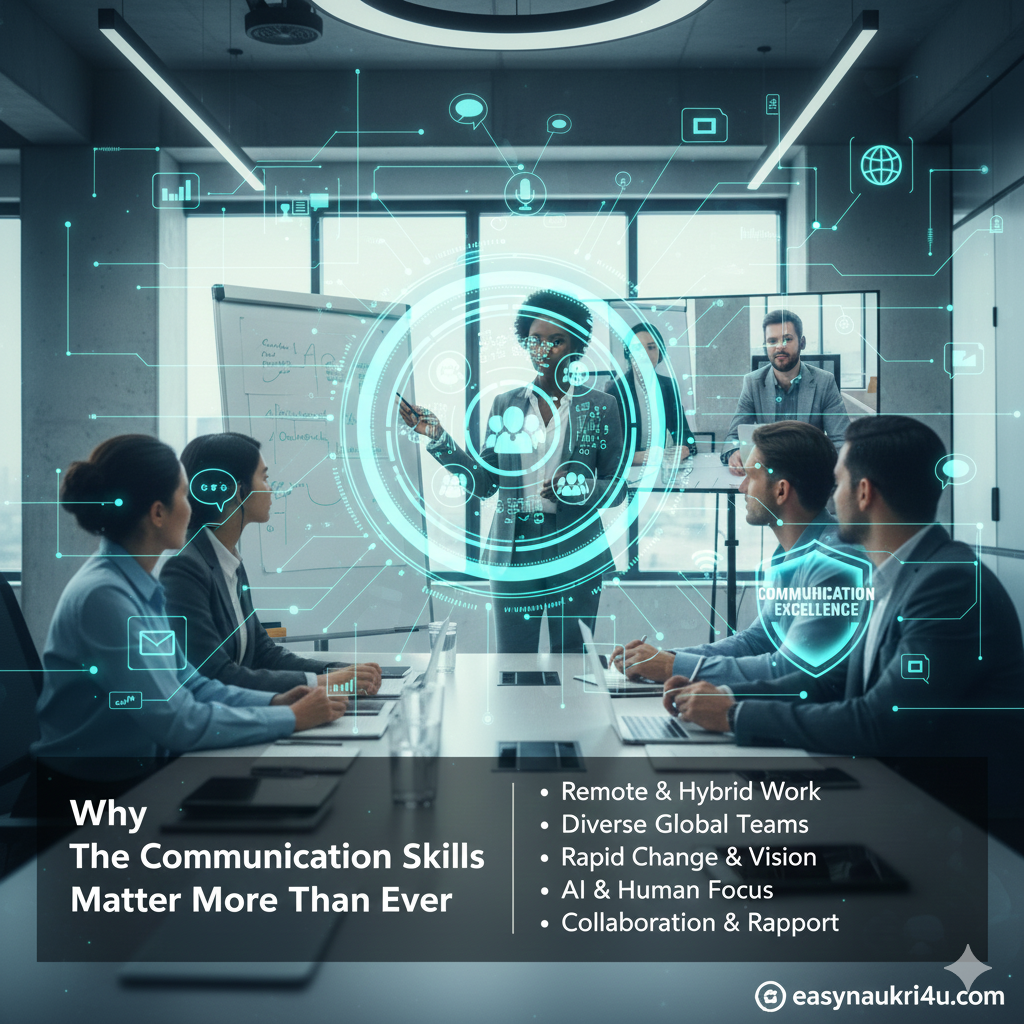
Exceptional communication skills have always been valuable, but several trends have amplified their importance in 2026 workplaces. Remote and hybrid work arrangements demand clearer, more intentional communication since casual hallway conversations no longer happen naturally. Diverse, global teams require cultural sensitivity and ability to communicate across differences. Rapid change necessitates communicating vision, managing uncertainty, and bringing people along through transitions. And AI handling routine tasks means human work increasingly focuses on areas requiring sophisticated communication—collaboration, negotiation, relationship building, and creative problem-solving.
Research consistently demonstrates that communication skills significantly predict career success, often more than technical expertise or intelligence alone. Professionals who communicate effectively advance faster, build stronger networks, influence outcomes, and create more impact than equally capable but less articulate peers.
The Cost of Poor Communication
Weak communication skills create cascading problems: misunderstandings waste time and create conflict, poor listening misses crucial information, inability to articulate ideas limits influence, avoidance of difficult conversations allows problems to fester, and ineffective presentations fail to persuade or inspire. Organizations lose productivity, engagement, and effectiveness when communication breaks down, while individuals with poor communication skills struggle to advance regardless of other capabilities.
Communication as Learnable Skill
The encouraging reality about communication skills is that they’re learnable and improvable through deliberate practice. Unlike innate traits, communication capabilities develop through awareness of current patterns, learning new techniques, practicing in real situations, seeking feedback, and continuously refining approach. Even people who consider themselves “not natural communicators” can develop strong communication skills that serve them throughout careers.
15 Essential Communication Skills
1. Active Listening and Genuine Attention
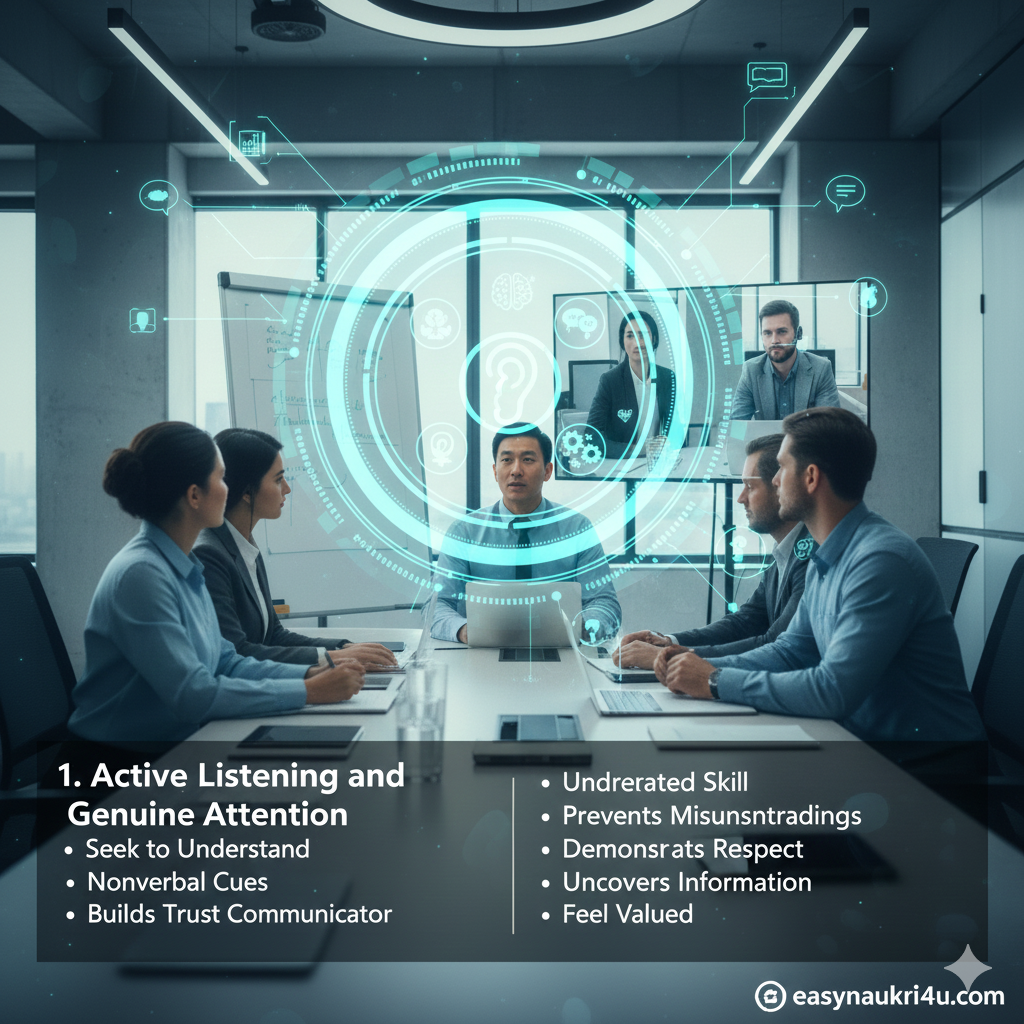
Active listening—fully concentrating on what others say rather than just waiting to speak—represents perhaps the most foundational yet underrated communication skills. Most people listen partially while planning responses, checking devices, or thinking about other matters. Active listeners give complete attention, seek to understand before being understood, ask clarifying questions, reflect back what they hear, and notice nonverbal communication alongside words.
Active listening builds trust, prevents misunderstandings, demonstrates respect, uncovers information you’d otherwise miss, and makes others feel valued. Ironically, being exceptional listener often makes you better communicator than being exceptional speaker.
Active Listening Development:
Full Attention:
Give complete focus when others speak—put away devices, make eye contact, orient your body toward them, and eliminate distractions. Physical attention signals psychological attention.
Resist Planning Responses:
Listen to understand rather than listening to respond. Don’t mentally rehearse what you’ll say next while others are speaking. Trust you’ll have good responses after fully understanding.
Clarifying Questions:
Ask questions ensuring you understand correctly: “Let me make sure I understand…” “Are you saying…?” “Help me understand what you mean by…” Questions demonstrate engagement and prevent assumptions.
Reflective Listening:
Paraphrase what you heard, reflecting it back: “So it sounds like you’re concerned about…” This confirms understanding while showing you’re truly listening.
Notice Nonverbal Cues:
Pay attention to tone, facial expressions, body language, and what’s not being said. Much communication happens nonverbally.
Comfortable Silence:
Allow silence for processing and thinking rather than rushing to fill every pause. Silence creates space for reflection and deeper sharing.
Suspend Judgment:
Listen without immediately evaluating or judging what’s being said. Seek first to understand perspective, even if you disagree.
For active listening training and practice exercises, explore: 👉 https://easynaukri4u.com/
2. Clear and Concise Articulation

Communicating ideas clearly and concisely—getting to the point without unnecessary complexity or verbosity—represents crucial communication skills in busy professional environments. Clear communicators organize thoughts logically, use simple language avoiding jargon, structure messages with clear beginnings and ends, provide appropriate context, and respect others’ time through brevity.
Unclear, rambling communication frustrates listeners, wastes time, creates misunderstandings, and diminishes your credibility. Clear articulation ensures your ideas receive fair consideration rather than getting lost in confused delivery.
Clear Communication Development:
Think Before Speaking:
Take moments to organize thoughts before speaking, especially on complex topics. Brief mental preparation dramatically improves clarity.
Structure Messages:
Use logical structures—state main point first, provide supporting details, and conclude clearly. Beginning-middle-end structure aids comprehension.
Simple Language:
Prefer simple words over complex ones, short sentences over long ones, and concrete examples over abstract concepts. Clarity beats impressiveness.
Eliminate Filler:
Reduce “um,” “like,” “you know,” and other verbal fillers through awareness and practice. Recording yourself reveals patterns you don’t notice.
Check Understanding:
After explaining complex topics, ask if people have questions or if anything needs clarification. Don’t assume clarity without confirming.
Edit Ruthlessly:
In writing, edit to eliminate unnecessary words. In speaking, practice getting to points directly without excessive preamble.
Audience Adaptation:
Adjust technical depth and language based on audience knowledge. Explain things differently to experts versus novices.
3. Emotional Intelligence in Communication
Emotional intelligence—understanding and managing your emotions while recognizing and influencing others’ emotions—profoundly affects communication effectiveness and represents essential communication skills. Emotionally intelligent communicators recognize how emotional states affect receptivity to messages, choose timing based on emotional context, adapt approach based on others’ emotional signals, and manage their own emotional reactions during difficult conversations.
Communication devoid of emotional intelligence often fails despite technically correct content because it ignores psychological realities affecting how messages are received and processed.
Emotional Intelligence Integration:
Self-Awareness:
Recognize your emotional state and how it affects your communication. When upset, angry, or stressed, your communication often deteriorates. Manage your state before important conversations.
Emotion Recognition:
Notice others’ emotional states through verbal and nonverbal cues. Adjust your communication based on whether they’re stressed, excited, defensive, or open.
Empathetic Communication:
Consider others’ perspectives, feelings, and concerns. Communicate in ways that acknowledge their experience and demonstrate understanding.
Timing Sensitivity:
Choose communication timing based on emotional context. Difficult messages delivered during stress create worse outcomes than same messages delivered when people are calm and receptive.
Emotional Regulation:
Manage your reactions during challenging conversations—stay calm when others are upset, respond thoughtfully rather than react defensively, and maintain professional composure under pressure.
Validation:
Acknowledge others’ feelings even when disagreeing with positions: “I understand this is frustrating” or “I can see why you’d be concerned about this.”
Tone Awareness:
Monitor your tone of voice, which often communicates more than words. Harsh tone undermines positive content while warm tone enhances even difficult messages.
4. Written Communication Excellence
Strong written communication skills—emails, reports, presentations, documentation—are essential since much professional communication happens in writing. Effective written communication is clear, concise, well-organized, grammatically correct, and appropriately formal for context and audience.
Poor writing creates misunderstandings, appears unprofessional, wastes readers’ time, and can damage your reputation and advancement potential. Conversely, excellent writing distinguishes you as polished professional whose communications are taken seriously.
Written Communication Development:
Clear Structure:
Organize written communication logically—important information first, supporting details following, clear conclusions. Use paragraphs, headings, and formatting aiding readability.
Audience Consideration:
Write for your audience—executives need summaries with key decisions, implementers need detailed instructions, diverse audiences need accessible language.
Conciseness:
Respect readers’ time by eliminating unnecessary words, getting to points directly, and using attachments for extensive details rather than burying people in long emails.
Professional Tone:
Match formality to context—more formal for senior leaders or external partners, more casual for close colleagues. Avoid overly casual language in professional contexts.
Grammar and Proofreading:
Errors undermine credibility. Proofread carefully, use grammar tools, and have important communications reviewed before sending.
Subject Lines:
Write clear, specific subject lines helping recipients prioritize and find messages later: “Budget Approval Needed by Friday” beats “Question.”
Action Clarity:
Make clear what you need from recipients—are you informing them, requesting action, asking for decision? Vague emails waste time.
For business writing courses and templates, visit: 👉 https://easynaukri4u.com/
5. Persuasive Communication and Influence
Persuasion—influencing others’ thinking, decisions, or actions—represents powerful communication skills enabling impact regardless of formal authority. Persuasive communicators understand audience motivations, frame messages addressing their interests, use logic and emotion strategically, build credibility, and create compelling narratives rather than just presenting facts.
Persuasion matters for selling ideas, gaining buy-in for initiatives, influencing resource allocation, advancing projects, and leading without authority. Professionals who persuade effectively create more impact than those who rely purely on position power.
Persuasive Communication:
Audience Analysis:
Understand what motivates your audience—what do they care about, what concerns them, what success looks like to them? Frame messages addressing their interests.
Credibility Building:
Establish credibility through expertise demonstration, track record reference, or third-party endorsement. People accept messages from credible sources more readily.
Logic and Evidence:
Support positions with data, examples, and logical reasoning. Evidence strengthens arguments while pure opinion rarely persuades.
Emotional Connection:
Combine logic with emotional appeal—stories, vivid examples, and connection to values. Decisions involve both head and heart.
Anticipate Objections:
Address potential concerns before they’re raised, showing you’ve considered counterarguments and have responses.
Clear Value Proposition:
Articulate clearly what’s in it for audience—how does your proposal benefit them, solve their problems, or advance their goals?
Call to Action:
End with clear request or next steps. Don’t just inform—specify what you want audience to do, think, or decide.
6. Difficult Conversation Navigation
Handling difficult conversations—addressing performance issues, delivering critical feedback, discussing conflicts, or communicating unwelcome news—represents essential communication skills that many professionals avoid despite their necessity. Effective navigators of difficult conversations prepare thoroughly, remain calm under emotional pressure, focus on outcomes rather than venting, separate people from problems, and follow up appropriately.
Avoiding difficult conversations allows small problems to become large crises while building reputation as someone who can’t handle confrontation. Conversely, handling them well demonstrates leadership readiness and professional maturity.
Difficult Conversation Skills:
Thorough Preparation:
Before difficult conversations, clarify objectives, gather relevant facts, plan key points, anticipate reactions, and manage your emotional state.
Private Setting:
Conduct difficult conversations privately, allowing people to process feedback without public embarrassment.
Direct Opening:
State purpose clearly rather than excessive small talk creating anxiety: “I want to discuss the project deadline that was missed…”
Specific Examples:
Use concrete examples rather than generalizations: “In the last three meetings, you’ve interrupted colleagues while they were speaking” versus “You’re not a team player.”
Listen Actively:
After sharing your perspective, genuinely listen to their viewpoint. Difficult conversations are dialogues, not monologues.
Focus on Future:
While addressing past issues, emphasize future solutions and improvements: “Going forward, here’s what I need…”
Follow-Up:
After difficult conversations, follow up to check progress, provide support, and acknowledge improvements.
7. Nonverbal Communication Awareness
Nonverbal communication—body language, facial expressions, tone of voice, eye contact, and physical presence—often communicates more powerfully than words and represents critical communication skills. Effective communicators align nonverbal signals with verbal messages, read others’ nonverbal cues, and use body language reinforcing their points.
Misaligned nonverbal communication undermines verbal messages—saying “I’m listening” while checking your phone communicates the opposite. Conversely, strong nonverbal communication amplifies verbal messages and builds connection.
Nonverbal Communication:
Eye Contact:
Maintain appropriate eye contact showing engagement without staring uncomfortably. Cultural differences affect appropriate levels.
Facial Expressions:
Ensure expressions match messages—smiling while delivering criticism creates confusion. Authentic expressions build trust.
Posture:
Stand or sit with open, confident posture. Slouching, crossing arms, or turning away suggests disengagement or defensiveness.
Gestures:
Use natural gestures emphasizing points without excessive or distracting movement. Gestures should enhance, not overwhelm.
Proximity:
Respect personal space preferences while creating appropriate connection. Different cultures and contexts require different distances.
Tone of Voice:
Monitor tone, which often communicates more than words. Harsh tone undermines positive content while warm tone enhances messages.
Presence:
Give full presence during conversations—put away devices, orient your body toward others, and eliminate multitasking.
For nonverbal communication training and body language resources, explore: 👉 https://easynaukri4u.com/
8. Presentation and Public Speaking
Presenting effectively to groups—whether small team meetings or large conferences—represents valuable communication skills that create visibility and influence. Strong presenters organize content logically, engage audiences, manage nerves, use visual aids effectively, handle questions confidently, and adapt to audience responses in real-time.
Presentation skills become increasingly important as careers advance, with senior professionals spending significant time presenting to teams, leadership, clients, and external audiences.
Presentation Skills:
Content Organization:
Structure presentations clearly—compelling opening, logical flow, memorable conclusion. Organize around 3-5 key points rather than overwhelming with information.
Audience Engagement:
Involve audience through questions, discussions, activities, or interactive elements rather than lecturing passively for extended periods.
Visual Aid Design:
Create clean, simple slides supporting rather than duplicating your spoken words. Avoid text-heavy slides that audience reads instead of listening to you.
Practice and Rehearsal:
Practice presentations multiple times, becoming comfortable with content and timing. Familiarity reduces nervousness and improves delivery.
Confident Delivery:
Speak clearly with appropriate volume and pace, make eye contact with various audience members, use natural gestures, and project confidence even when nervous.
Question Handling:
Anticipate potential questions, listen carefully to questions asked, answer concisely, and admit when you don’t know something rather than bluffing.
Nervous Management:
Use techniques like deep breathing, power poses, and reframing nervousness as excitement. Some nervousness is normal and often not as visible as you fear.
9. Conflict Resolution and Mediation
Navigating conflicts constructively—addressing disagreements without damaging relationships—represents advanced communication skills essential for leadership and teamwork. Effective conflict navigators stay calm during tensions, separate positions from underlying interests, help parties find common ground, focus on future solutions rather than past blame, and facilitate agreements both sides can support.
Poorly handled conflicts escalate into damaged relationships and reduced team effectiveness, while skillful conflict navigation strengthens relationships and produces better solutions than avoiding disagreements.
Conflict Resolution:
Early Intervention:
Address conflicts early before they escalate and become entrenched. Small disagreements are easier to resolve than full-blown conflicts.
Private Discussion:
Handle conflicts privately when possible, allowing people to speak freely without audience pressure.
Active Listening:
Give both sides opportunity to share perspectives without interruption. Often people just want to be heard and understood.
Underlying Interests:
Look beneath stated positions to underlying interests and needs. Positions often conflict while interests can be compatible.
Common Ground:
Identify areas of agreement or shared goals. Building from common ground makes progress easier than focusing exclusively on disagreements.
Solution Focus:
Shift from dwelling on problems to generating solutions. Ask: “What would resolve this?” or “How can we move forward?”
Neutral Language:
Use neutral language describing situations rather than blaming: “The deadline was missed” rather than “You failed to meet the deadline.”
10. Adaptability Across Communication Styles
Adapting communication style to different audiences, contexts, and purposes—communicating differently with executives versus front-line staff, formal versus casual situations, or written versus verbal channels—represents sophisticated communication skills that enhance effectiveness. Adaptable communicators read situations accurately, adjust formality appropriately, match depth to audience knowledge, and choose channels strategically.
Inflexible communication—using same approach regardless of context—reduces effectiveness and can create misunderstandings or appear tone-deaf.
Communication Adaptability:
Audience Assessment:
Before communicating, consider: Who is my audience? What do they know? What do they need? How should I adjust my approach?
Formality Calibration:
Adjust formality to context—more formal with senior leaders or external partners, more casual with peers or direct reports. Reading room accurately prevents being too casual or too stiff.
Detail Level:
Provide appropriate detail—executives typically want summaries and key decisions, implementers need step-by-step instructions, technical experts expect depth.
Channel Selection:
Choose appropriate channels—complex discussions need meetings, urgent matters may need calls, documented decisions belong in email, quick questions suit instant messaging.
Cultural Sensitivity:
Adapt to cultural differences in communication norms—directness expectations, hierarchy respect, time orientation, and emotional expression all vary across cultures.
Personality Accommodation:
Adjust to different personality styles—some prefer data and logic, others want relationship connection first; some like details, others want big picture.
For communication style assessments and adaptation training, visit: 👉 https://easynaukri4u.com/
11. Feedback Delivery and Reception
Giving and receiving feedback effectively—delivering criticism constructively and receiving it gracefully—represents critical communication skills for continuous improvement and professional relationships. Effective feedback deliverers are specific, timely, balanced, future-focused, and empathetic. Good feedback receivers listen without defensiveness, seek clarification, reflect on input, and act on useful feedback.
Poor feedback delivery damages relationships and fails to improve performance, while defensive reception prevents learning and growth.
Feedback Communication:
Specific and Behavioral:
Provide specific examples of behaviors and impacts rather than vague generalizations or character judgments: “In yesterday’s meeting, you interrupted Sarah three times” versus “You’re rude.”
Timely Delivery:
Give feedback soon after relevant events while details are fresh and correction is most useful. Don’t save up months of issues for annual reviews.
Balanced Approach:
Acknowledge strengths alongside developmental feedback. Pure criticism demoralizes while balanced feedback motivates improvement.
Forward Focus:
Emphasize future improvement rather than dwelling on past failures: “Going forward, I’d like to see…” or “Next time, try…”
Two-Way Dialogue:
After sharing feedback, invite response and discussion. Feedback conversations should be dialogues, not monologues.
Graceful Reception:
When receiving feedback, listen without immediately defending, ask clarifying questions, thank people for input, and consider it thoughtfully before deciding how to respond.
Action Follow-Through:
Act on useful feedback, demonstrating you value input by making visible improvements based on what you’ve learned.
12. Meeting Facilitation and Management
Running effective meetings—with clear agendas, active participation, productive discussions, documented decisions, and respected time limits—represents valuable communication skills for leaders and project managers. Good facilitators prepare thoroughly, start and end on time, keep discussions focused, ensure all voices are heard, make decisions efficiently, and follow up appropriately.
Poorly run meetings waste enormous time and frustrate participants, damaging facilitators’ credibility and team effectiveness.
Meeting Facilitation:
Clear Purpose:
Ensure every meeting has clear purpose and desired outcomes. If objectives can be achieved without meeting, use alternative communication.
Advance Preparation:
Send agendas beforehand, share relevant materials for review, and give participants time to prepare meaningful contributions.
Time Management:
Start punctually, allocate appropriate time to agenda items, keep discussions on track, and end on schedule or early. Respect participants’ time.
Inclusive Participation:
Actively invite quieter participants to share, prevent dominant personalities from monopolizing, and create safe space for diverse perspectives.
Decision Documentation:
Clearly document decisions made, action items assigned, owners responsible, and deadlines established. Share notes promptly after meetings.
Follow-Up:
Check progress on action items, hold people accountable for commitments, and schedule follow-up meetings when necessary.
Meeting Alternatives:
Consider whether meetings could be replaced by emails, shared documents, or asynchronous communication accomplishing same goals more efficiently.
13. Storytelling and Narrative Communication
Using stories and narratives to communicate—making points through examples, case studies, and personal experiences rather than just facts and abstractions—represents powerful communication skills that enhance engagement, memorability, and persuasion. Stories activate different brain areas than pure information, creating emotional connection and better retention.
Effective storytellers select relevant stories, structure them with clear arcs, include vivid details, and connect stories explicitly to points being made.
Storytelling Skills:
Relevant Selection:
Choose stories directly relevant to points you’re making. Tangential stories confuse rather than clarify.
Clear Structure:
Structure stories with beginning (situation/context), middle (challenge/conflict), and end (resolution/outcome). This arc creates engagement and satisfaction.
Vivid Details:
Include specific, sensory details making stories come alive without excessive length or irrelevant tangents.
Emotional Connection:
Share authentic emotions and human elements. Stories’ power comes from emotional resonance, not just facts.
Point Connection:
Explicitly connect stories to points you’re making rather than assuming audiences will make connections themselves.
Personal Vulnerability:
Appropriately share personal stories including challenges and failures, not just successes. Vulnerability builds connection and authenticity.
Variety:
Use mix of personal experiences, case studies, historical examples, and hypotheticals rather than relying exclusively on one story type.
For storytelling workshops and narrative communication training, explore: 👉 https://easynaukri4u.com/
14. Cross-Cultural Communication Competence
Communicating effectively across cultural differences—understanding how culture affects communication norms, adapting to different cultural contexts, and building bridges across differences—represents increasingly essential communication skills in global, diverse workplaces. Culturally competent communicators recognize their own cultural conditioning, learn about different cultural communication styles, and adapt approaches respectfully.
Cultural incompetence leads to misunderstandings, offense, damaged relationships, and missed opportunities in diverse environments.
Cross-Cultural Communication:
Cultural Self-Awareness:
Understand your own cultural communication norms—directness levels, hierarchy respect, time orientation, emotional expression—recognizing these aren’t universal.
Learning Orientation:
Study cultural differences affecting communication—how different cultures approach conflict, give feedback, show respect, make decisions, and build relationships.
Assumption Suspension:
Don’t assume your communication style is “normal” or “right.” Recognize different doesn’t mean wrong—just different cultural norms.
Clarification Seeking:
When working across cultures, ask clarifying questions rather than assuming you understand. Check that your messages are received as intended.
Adaptation Practice:
Adjust communication style when working across cultures—more or less direct, more or less formal, faster or slower pace—based on others’ preferences.
Respectful Curiosity:
Ask respectfully about cultural preferences and norms rather than making assumptions or ignoring cultural factors.
Inclusive Language:
Use inclusive language accessible to non-native speakers—simpler words, clearer structure, fewer idioms and cultural references.
15. Digital and Remote Communication Proficiency
Communicating effectively through digital channels and in remote/hybrid work environments—using video calls, instant messaging, email, and collaboration platforms appropriately—represents modern communication skills essential in 2026 workplaces. Digital communication requires extra clarity since nonverbal cues are limited, intentional relationship building to maintain connection without physical presence, and strategic channel selection matching communication types to appropriate platforms.
Poor digital communication creates misunderstandings, damages relationships, and reduces team effectiveness in distributed work environments.
Digital Communication:
Video Presence:
Use video for important conversations when possible, enabling facial expressions and nonverbal communication. Ensure good lighting, clean background, and professional appearance.
Channel Appropriateness:
Match channels to communication—instant messaging for quick questions, email for documented decisions, video for complex discussions, project management tools for task coordination.
Written Clarity:
Extra care with written digital communication since tone and nuance are easily misunderstood. Read messages from recipient perspective before sending.
Response Expectations:
Set clear expectations about response times for different channels. Not everything requires immediate response despite real-time delivery.
Relationship Building:
Intentionally build relationships in remote contexts—small talk before diving into business, virtual coffee chats, sharing appropriate personal updates, celebrating milestones.
Meeting Etiquette:
Mute when not speaking, use appropriate backgrounds, look at camera when speaking, minimize distractions, and fully engage rather than multitasking.
Asynchronous Communication:
Become skilled at asynchronous communication—documenting decisions, sharing updates clearly, and enabling collaboration across time zones without requiring simultaneous presence.
Developing Communication Skills Systematically
Self-Assessment and Awareness
Improving communication skills begins with honest self-assessment of current capabilities and patterns. Seek feedback from colleagues, managers, and mentors about your communication strengths and development areas. Record yourself presenting or in meetings to observe patterns you don’t notice in the moment.
Deliberate Practice
Communication skills improve through deliberate practice—consciously applying techniques, seeking challenging situations, reflecting on what worked, and continuously refining approach. Practice in real situations while being mindful of specific skills you’re developing.
Continuous Learning
Study communication through books, courses, workshops, and observation of excellent communicators. Analyze what makes effective communicators successful and incorporate their techniques into your approach.
Feedback Integration
Actively seek feedback about your communication, receive it gracefully, and act on useful input. Regular feedback provides information guiding continuous improvement.
Conclusion: Communication as Career Accelerator
Mastering these fifteen essential communication skills—from active listening and clear articulation to difficult conversations and digital communication—creates foundation for exceptional professional success. While technical expertise opens doors, communication capabilities determine how far you advance, how much influence you create, and how effectively you lead and collaborate.
The encouraging reality about communication skills is their learnability and improvability through deliberate practice. Even people who don’t consider themselves natural communicators can develop strong capabilities through awareness, learning, practice, and feedback. Small improvements in communication effectiveness compound into significant career advantages over time.
Start enhancing your communication skills today by selecting 2-3 areas from this guide needing development. Whether that means practicing active listening, preparing for difficult conversations, improving presentation skills, or adapting communication style, focused improvement in key areas accelerates your effectiveness.
Your communication skills affect every professional interaction, relationship, and opportunity throughout your career. Investing in these capabilities provides returns across all aspects of professional life while making you more effective, influential, and successful.
Take action now by identifying one communication area to practice this week, seeking feedback on your communication patterns, or committing to one new communication technique. Consistent small improvements create dramatic capability enhancement over months and years.
For comprehensive communication skills training, coaching, workshops, and ongoing development support helping you become exceptional communicator, visit: 👉 https://easynaukri4u.com/
The professional success you seek depends significantly on how effectively you communicate ideas, build relationships, influence outcomes, and connect with others. By systematically developing these essential communication skills, you transform from adequate to exceptional communicator—creating career advantages that serve you throughout your professional journey.