Cloud Computing Careers 2026: The Complete Educational Guide to Building Your Future
BlogIntroduction
The cloud has fundamentally transformed how organizations build and deploy technology. Cloud computing careers 2026 represent some of the most stable, lucrative, and future-proof opportunities in the entire technology sector. Cloud Computing Careers 2026
visit our website – EasyNaukri4U – India’s Leading Government Job Portal
visit our resume builder – Government Jobs - EasyNaukri4U
“According to LinkedIn’s Global Talent Trends Report, recruiters spend an average of six to seven seconds reviewing each resume.” Cloud Computing Careers 2026
But what exactly is cloud computing? Why has it become so critical? And how can you build a successful career in this field?
This educational guide answers these questions comprehensively. We’ll explain core concepts, explore career paths, and provide actionable roadmaps. Cloud Computing Careers 2026
At EasyNaukri4u.com, cloud-related job postings have increased by 320% over two years. Let’s understand why and how you can benefit.
Understanding Cloud Computing: The Fundamentals
Before exploring careers, let’s build a solid understanding of what cloud computing actually means.
What Is Cloud Computing?
The Basic Definition
Cloud computing delivers computing services over the internet. Instead of owning physical servers, you rent computing power from providers. Cloud Computing Careers 2026
Think of it like electricity. You don’t own a power plant. You pay for what you use from a utility company.
Similarly, cloud providers own massive data centers. You access their resources on-demand and pay based on usage.
The Five Essential Characteristics
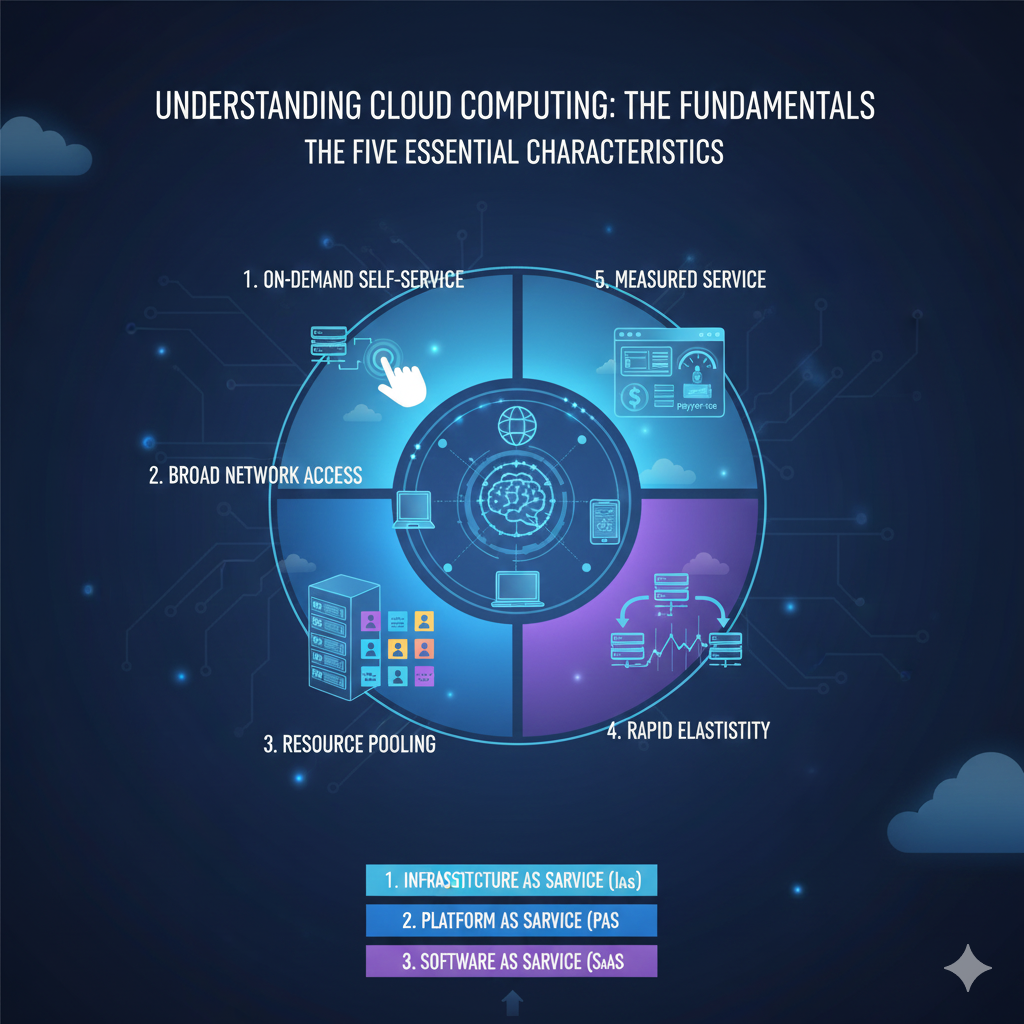
The National Institute of Standards and Technology (NIST) defines five characteristics of cloud computing:
1. On-Demand Self-Service
Users provision resources without human interaction. Need a server? Click a button. Need more storage? Adjust a slider.
This eliminates weeks of procurement processes. Resources are available in minutes, not months. Cloud Computing Careers 2026
2. Broad Network Access
Services are accessible over the internet. Any device with connectivity can reach cloud resources.
This enables remote work, mobile applications, and global accessibility.
3. Resource Pooling
Providers serve multiple customers from shared infrastructure. This multi-tenancy model enables cost efficiency.
Your virtual server might share physical hardware with other customers. But isolation ensures security and privacy. Cloud Computing Careers 2026
4. Rapid Elasticity
Resources scale up or down based on demand. Handle traffic spikes without over-provisioning for peaks.
This elasticity is automatic or manual. Either way, it’s dramatically faster than traditional infrastructure.
5. Measured Service
Usage is monitored and reported. You pay only for what you consume.
This pay-as-you-go model transforms capital expenditure into operational expenditure.
Understanding these characteristics is fundamental for cloud computing careers 2026.
The Three Service Models Explained
Cloud services are categorized into three models. Each offers different levels of abstraction and control.
Infrastructure as a Service (IaaS)
IaaS provides virtualized computing resources. You rent servers, storage, and networking.
What the provider manages:
- Physical data centers
- Networking hardware
- Storage systems
- Virtualization layer
What you manage:
- Operating systems
- Middleware
- Runtime environments
- Applications
- Data
Examples: Amazon EC2, Azure Virtual Machines, Google Compute Engine
When to use: When you need maximum control over your environment. Suitable for lift-and-shift migrations and custom configurations. Cloud Computing Careers 2026
Platform as a Service (PaaS)
PaaS provides a platform for application development. The infrastructure is fully managed.
What the provider manages:
- Everything in IaaS
- Operating systems
- Middleware
- Runtime environments
What you manage:
- Applications
- Data
Examples: Heroku, Google App Engine, Azure App Service
When to use: When you want to focus on coding without infrastructure concerns. Ideal for application development teams. Cloud Computing Careers 2026
Software as a Service (SaaS)
SaaS delivers complete applications over the internet. Users access software through browsers.
What the provider manages:
- Everything in PaaS
- Applications
- Data management
What you manage:
- Configuration
- User access
Examples: Salesforce, Microsoft 365, Google Workspace
When to use: When you need ready-to-use applications without development or maintenance. Cloud Computing Careers 2026
This knowledge forms the foundation for cloud computing careers 2026.
The Four Deployment Models
Cloud infrastructure can be deployed in different ways. Each model serves different needs.
Public Cloud
Infrastructure is owned by cloud providers. Resources are shared among multiple organizations.
Advantages:
- No capital investment
- Unlimited scalability
- Global availability
- Latest technology access
Considerations:
- Less control
- Potential compliance challenges
- Shared infrastructure concerns
Examples: AWS, Microsoft Azure, Google Cloud Platform
Private Cloud
Infrastructure is dedicated to a single organization. It can be on-premises or hosted. Cloud Computing Careers 2026
Advantages:
- Maximum control
- Enhanced security
- Compliance flexibility
- Customization options
Considerations:
- Higher costs
- Maintenance responsibility
- Scalability limits
Use cases: Highly regulated industries, sensitive data handling, legacy application hosting.
Hybrid Cloud
Combines public and private clouds. Workloads can move between environments.
Advantages:
- Flexibility
- Cost optimization
- Gradual migration path
- Best of both worlds
Considerations:
- Complexity
- Integration challenges
- Skill requirements
Use cases: Most enterprise organizations now adopt hybrid approaches.
Multi-Cloud
Uses multiple public cloud providers. Avoids vendor lock-in and optimizes capabilities.
Advantages:
- No single vendor dependency
- Best services from each provider
- Redundancy and resilience
- Negotiation leverage
Considerations:
- Management complexity
- Skill requirements across platforms
- Integration challenges
Understanding deployment models is essential for cloud computing careers 2026.
Check EasyNaukri4u.com for opportunities across all cloud deployment types. Cloud Computing Careers 2026
The Major Cloud Platforms: An Educational Overview
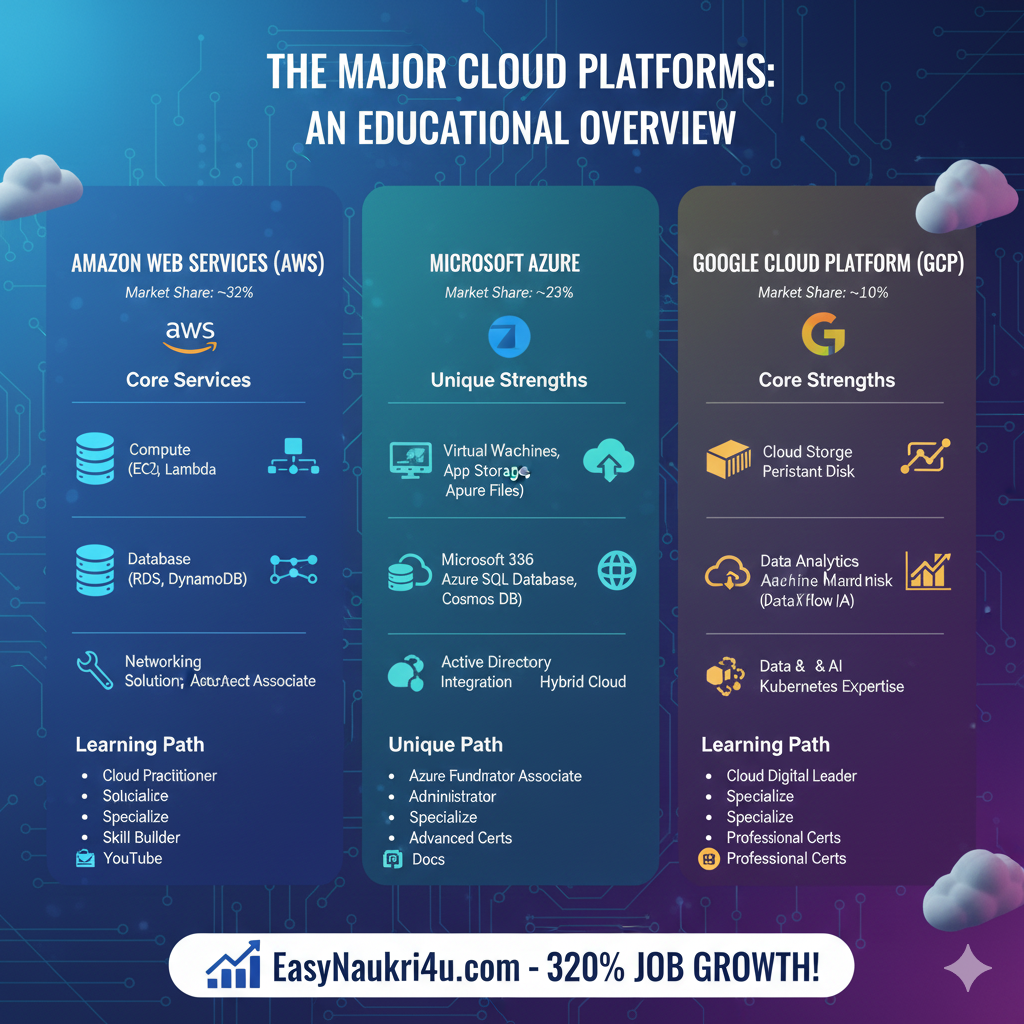
Three providers dominate the market. Understanding each is crucial for career success.
Amazon Web Services (AWS)
AWS pioneered commercial cloud computing. It launched in 2006 and maintains market leadership.
Market Position
AWS holds approximately 32% market share. It offers 200+ services across all categories.
Most organizations using cloud have some AWS presence. This makes AWS skills highly valuable.
Core Services to Learn
Compute:
- EC2 (Elastic Compute Cloud): Virtual servers
- Lambda: Serverless functions
- ECS/EKS: Container orchestration
- Elastic Beanstalk: PaaS offering
Storage:
- S3 (Simple Storage Service): Object storage
- EBS (Elastic Block Store): Block storage
- EFS (Elastic File System): File storage
- Glacier: Archive storage
Database:
- RDS (Relational Database Service): Managed SQL databases
- DynamoDB: NoSQL database
- Aurora: High-performance relational database
- Redshift: Data warehouse
Networking:
- VPC (Virtual Private Cloud): Network isolation
- Route 53: DNS service
- CloudFront: Content delivery network
- API Gateway: API management
Learning Path
- Start with AWS Cloud Practitioner certification
- Progress to Solutions Architect Associate
- Specialize based on interest (DevOps, Security, Data)
- Advanced certifications for senior roles
Free Learning Resources:
- AWS Free Tier (12 months free access)
- AWS Skill Builder
- AWS Documentation
- AWS YouTube channel
Microsoft Azure
Azure leverages Microsoft’s enterprise relationships. It’s the fastest-growing major cloud.
Market Position
Azure holds approximately 23% market share. Growth rate exceeds AWS.
Organizations with Microsoft investments often prefer Azure. Integration with existing tools is seamless.
Core Services to Learn
Compute:
- Virtual Machines: IaaS compute
- App Service: PaaS web hosting
- Azure Functions: Serverless computing
- Azure Kubernetes Service: Container orchestration
Storage:
- Blob Storage: Object storage
- Azure Files: Managed file shares
- Disk Storage: Block storage
- Archive Storage: Long-term retention
Database:
- Azure SQL Database: Managed SQL Server
- Cosmos DB: Multi-model NoSQL
- Azure Database for PostgreSQL/MySQL
- Synapse Analytics: Data warehouse
Networking:
- Virtual Network: Network isolation
- Azure DNS: Domain management
- Azure CDN: Content delivery
- Application Gateway: Load balancing
Unique Strengths:
- Microsoft 365 integration
- Active Directory integration
- Hybrid cloud capabilities
- Enterprise relationships
Learning Path
- Start with Azure Fundamentals (AZ-900)
- Progress to Administrator Associate (AZ-104)
- Specialize in development, security, or data
- Advanced certifications for expertise
This knowledge is essential for cloud computing careers 2026.
Google Cloud Platform (GCP)
GCP brings Google’s engineering excellence to cloud services. It excels in data and AI.
Market Position
GCP holds approximately 10% market share. Growth remains strong.
Organizations prioritizing data analytics and machine learning often choose GCP.
Core Services to Learn
Compute:
- Compute Engine: Virtual machines
- App Engine: PaaS platform
- Cloud Functions: Serverless
- Google Kubernetes Engine: Container orchestration
Storage:
- Cloud Storage: Object storage
- Persistent Disk: Block storage
- Filestore: File storage
- Archive Storage: Cold storage
Database:
- Cloud SQL: Managed relational databases
- Firestore: Document database
- Bigtable: Wide-column database
- BigQuery: Data warehouse (flagship product)
Data and AI:
- BigQuery: Serverless data warehouse
- Vertex AI: Machine learning platform
- Dataflow: Stream/batch processing
- Looker: Business intelligence
Unique Strengths:
- Data analytics leadership
- Machine learning capabilities
- Kubernetes expertise (Google created it)
- Strong networking infrastructure
Learning Path
- Start with Cloud Digital Leader
- Progress to Associate Cloud Engineer
- Specialize in data, ML, or architecture
- Professional certifications for expertise
Understanding all three platforms maximizes cloud computing careers 2026 opportunities.
Cloud Career Paths: Detailed Role Analysis
Cloud computing careers 2026 encompass diverse roles. Let’s examine each in depth. Cloud Computing Careers 2026
Cloud Engineer
Cloud engineers build and maintain cloud infrastructure. This is the foundational cloud role. Cloud Computing Careers 2026
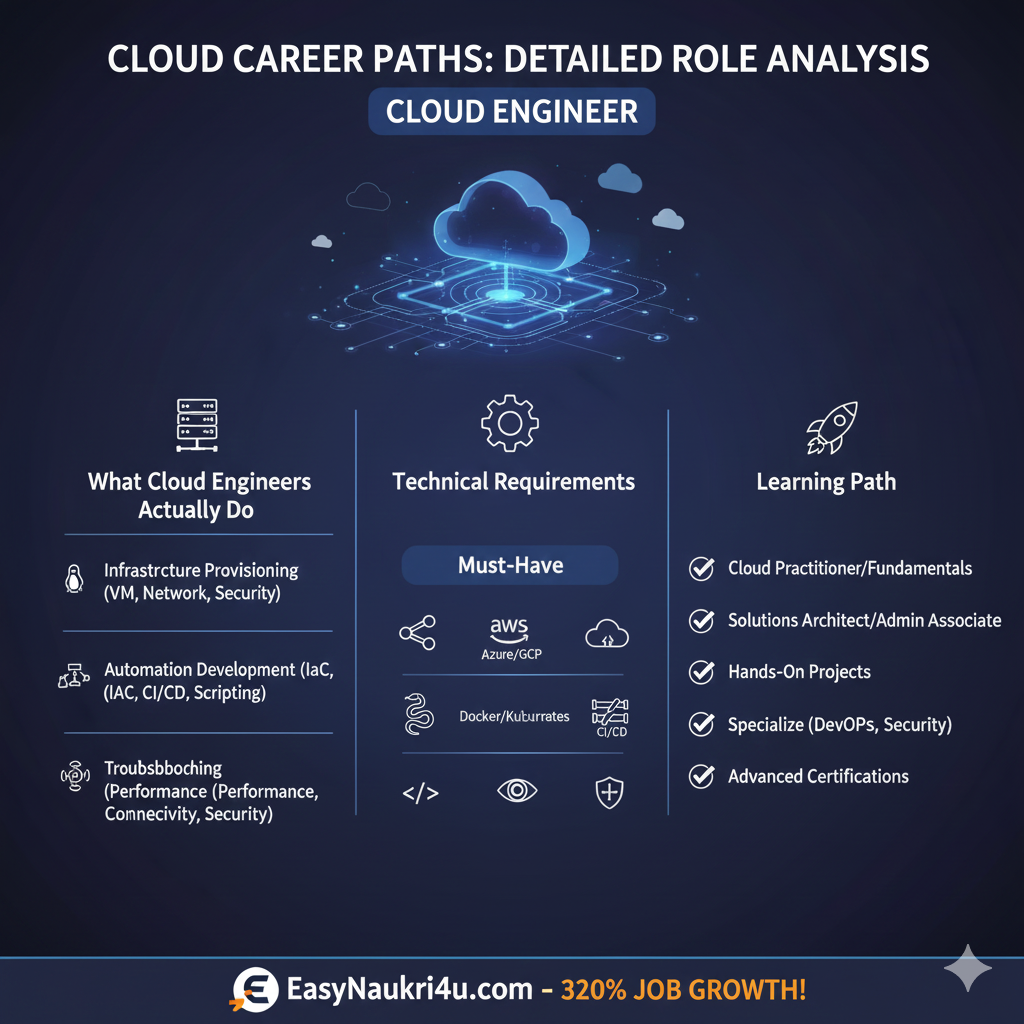
What Cloud Engineers Actually Do
Daily responsibilities vary but typically include:
Infrastructure Provisioning:
- Creating virtual machines and networks
- Configuring storage solutions
- Setting up security groups and access controls
- Implementing infrastructure as code
Automation Development:
- Writing Terraform or CloudFormation templates
- Creating deployment pipelines
- Automating routine maintenance tasks
- Building monitoring and alerting systems
Troubleshooting:
- Diagnosing performance issues
- Resolving connectivity problems
- Investigating security incidents
- Optimizing resource utilization
Technical Requirements
Essential skills include:
Must-Have:
- Linux/Windows administration
- Networking fundamentals (TCP/IP, DNS, HTTP)
- At least one major cloud platform
- Scripting (Python, Bash, PowerShell)
- Infrastructure as code (Terraform or CloudFormation)
Good-to-Have:
- Container technologies (Docker, Kubernetes)
- CI/CD pipelines
- Monitoring tools (CloudWatch, Datadog)
- Security best practices
Salary Expectations
| Experience | Salary Range |
|---|---|
| Entry Level (0-2 years) | $75,000 – $100,000 |
| Mid Level (3-5 years) | $100,000 – $140,000 |
| Senior Level (5+ years) | $140,000 – $180,000 |
Visit EasyNaukri4u.com for cloud engineer positions at all levels.
Cloud Architect
Cloud architects design comprehensive cloud solutions. They create blueprints others implement.
The Architect’s Role Explained
Architects work at a higher abstraction level:
Solution Design:
- Evaluating business requirements
- Designing system architectures
- Selecting appropriate services
- Creating technical documentation
Best Practices Enforcement:
- Establishing cloud standards
- Reviewing designs for compliance
- Mentoring engineering teams
- Conducting architecture reviews
Strategic Planning:
- Cloud migration strategies
- Cost optimization plans
- Technology roadmaps
- Vendor evaluation
Educational Requirements
Most architects have:
Experience:
- 7+ years in IT
- 3+ years specifically in cloud
- Background in infrastructure or development
Knowledge Areas:
- Deep understanding of chosen platform(s)
- Enterprise architecture frameworks
- Security and compliance requirements
- Cost management strategies
Certifications:
- AWS Solutions Architect Professional
- Azure Solutions Architect Expert
- Google Cloud Professional Architect
Salary Expectations
| Level | Salary Range |
|---|---|
| Solution Architect | $140,000 – $180,000 |
| Senior Architect | $180,000 – $220,000 |
| Principal Architect | $220,000 – $280,000 |
DevOps Engineer
DevOps engineers bridge development and operations. They automate software delivery.
Understanding DevOps
DevOps is a cultural and technical practice:
Cultural Aspects:
- Collaboration between teams
- Shared responsibility
- Continuous improvement
- Blameless postmortems
Technical Practices:
- Continuous Integration (CI)
- Continuous Deployment (CD)
- Infrastructure as Code
- Monitoring and observability
Daily Activities:
- Building and maintaining CI/CD pipelines
- Managing container orchestration
- Implementing monitoring solutions
- Automating deployment processes
Essential Tools to Learn
CI/CD:
- Jenkins, GitLab CI, GitHub Actions
- ArgoCD, Spinnaker
Containers:
- Docker (containerization)
- Kubernetes (orchestration)
- Helm (package management)
Infrastructure as Code:
- Terraform (multi-cloud)
- Ansible (configuration management)
- Pulumi (programming languages)
Monitoring:
- Prometheus + Grafana
- ELK Stack
- Datadog, New Relic
Salary Expectations
| Experience | Salary Range |
|---|---|
| Entry Level | $80,000 – $110,000 |
| Mid Level | $110,000 – $150,000 |
| Senior Level | $150,000 – $200,000 |
Cloud computing careers 2026 in DevOps remain highly sought after.
Cloud Security Specialist
Security specialists protect cloud environments. This specialization is increasingly critical.
Why Cloud Security Is Different
Cloud security introduces unique considerations:
Shared Responsibility Model:
- Providers secure the cloud infrastructure
- Customers secure what they put in the cloud
- Boundaries vary by service model
New Attack Surfaces:
- Misconfigured services
- Overly permissive access
- Exposed storage buckets
- Insecure APIs
Compliance Complexity:
- Data residency requirements
- Industry regulations
- Cross-border considerations
- Audit requirements
Key Knowledge Areas
Identity and Access Management:
- Least privilege principles
- Role-based access control
- Multi-factor authentication
- Privileged access management
Network Security:
- Virtual private clouds
- Security groups and NACLs
- Web application firewalls
- DDoS protection
Data Protection:
- Encryption at rest and in transit
- Key management
- Data classification
- Backup and recovery
Compliance:
- GDPR, HIPAA, PCI-DSS
- SOC 2, ISO 27001
- Audit preparation
- Control implementation
Salary Expectations
| Role | Salary Range |
|---|---|
| Cloud Security Engineer | $120,000 – $160,000 |
| Senior Security Engineer | $160,000 – $200,000 |
| Cloud Security Architect | $180,000 – $240,000 |
Check EasyNaukri4u.com for cloud security opportunities.
Educational Roadmaps for Cloud Computing Careers 2026
Let’s create detailed learning paths for different starting points. Cloud Computing Careers 2026
Roadmap for Complete Beginners
If you’re new to IT, here’s a structured approach:
Phase 1: IT Fundamentals (Months 1-3)
Month 1: Computing Basics
- How computers work
- Operating system concepts
- File systems and storage
- Basic troubleshooting
Recommended resource: CompTIA IT Fundamentals+ study materials
Month 2: Networking Fundamentals
- OSI and TCP/IP models
- IP addressing and subnetting
- DNS and DHCP
- Routing and switching basics
Recommended resource: CompTIA Network+ materials, Professor Messer videos Cloud Computing Careers 2026
Month 3: Linux Fundamentals
- Command line navigation
- File permissions
- User management
- Package management
Recommended resource: Linux Foundation free courses, Linux Journey website
Phase 2: Cloud Foundations (Months 4-6)
Month 4: Cloud Concepts
- Service models (IaaS, PaaS, SaaS)
- Deployment models
- Cloud economics
- Major provider overview
Recommended resource: AWS Cloud Practitioner preparation
Month 5: First Platform Deep Dive
- Choose AWS, Azure, or GCP
- Core compute services
- Storage fundamentals
- Basic networking
Recommended resource: Provider’s free training platform
Month 6: Hands-On Practice
- Create free tier account
- Deploy first virtual machine
- Set up basic web server
- Experiment with storage
Critical: Hands-on experience beats passive learning.
Phase 3: Specialization (Months 7-12)
Months 7-9: Core Skills Development
- Infrastructure as code (Terraform)
- Scripting (Python or Bash)
- Container basics (Docker)
- CI/CD fundamentals
Months 10-12: First Certification
- AWS Solutions Architect Associate, OR
- Azure Administrator Associate, OR
- Google Cloud Associate
This roadmap prepares you for entry-level cloud computing careers 2026.
Roadmap for IT Professionals Transitioning
If you have IT experience, leverage existing knowledge:
Phase 1: Cloud Mapping (Months 1-2)
Map existing skills to cloud:
- On-premises servers → Cloud compute
- Physical networks → Virtual networks
- Local storage → Cloud storage
- Manual processes → Automation
Focus: Understanding how familiar concepts translate to cloud.
Phase 2: Intensive Platform Learning (Months 3-4)
Choose primary platform based on:
- Current employer’s direction
- Local job market demand
- Personal interest
Deep dive into:
- Compute services
- Networking and VPCs
- Storage options
- Security fundamentals
Phase 3: Automation and Modern Practices (Months 5-6)
Learn essential tools:
- Infrastructure as code
- Configuration management
- Container orchestration
- CI/CD pipelines
Phase 4: Certification and Positioning (Months 7-8)
Obtain professional-level certification:
- AWS Solutions Architect Associate/Professional
- Azure Administrator/Architect
- GCP Professional Cloud Architect
Update professional presence:
- Resume revision
- LinkedIn optimization
- Portfolio development
Roadmap for Developers Moving to Cloud
Developers have advantages in cloud computing careers 2026.
Phase 1: Infrastructure Understanding (Month 1)
Learn what you’ve been abstracted from:
- How applications run on servers
- Networking basics
- Storage systems
- Operating system administration
Phase 2: Cloud-Native Development (Months 2-3)
Modern application patterns:
- Microservices architecture
- Container-based deployment
- Serverless computing
- API-driven design
Essential tools:
- Docker for containerization
- Kubernetes basics
- Serverless frameworks
- Cloud-native databases
Phase 3: DevOps Integration (Months 4-5)
Complete the development lifecycle:
- CI/CD pipelines
- Infrastructure as code
- Automated testing
- Deployment strategies
Phase 4: Platform Expertise (Month 6)
Developer-focused services:
- AWS Lambda, API Gateway
- Azure Functions, App Service
- Google Cloud Run, Cloud Functions
- Managed databases and caching
Visit EasyNaukri4u.com for developer-focused cloud positions. Cloud Computing Careers 2026
Certifications: An Educational Analysis
Certifications validate knowledge and open doors. Let’s understand them deeply.
How Certifications Work
Certification Structure
Most cloud certifications follow tiered structures:
Foundational Level:
- Broad conceptual knowledge
- No prerequisites
- Multiple choice format
- 60-90 minute exams
Associate Level:
- Hands-on knowledge required
- Some experience recommended
- Scenario-based questions
- 90-130 minute exams
Professional Level:
- Deep expertise required
- Years of experience expected
- Complex scenarios
- 180-minute exams
Specialty Level:
- Focused domain expertise
- Specific use case knowledge
- Technical depth
- Variable formats
AWS Certifications Detailed
AWS Cloud Practitioner (CLF-C02)
Purpose: Validate foundational understanding
Who should take it:
- Complete beginners
- Sales and business professionals
- Managers needing cloud literacy
Exam details:
- 65 questions
- 90 minutes
- 70% passing score
- $100 exam fee
Topics covered:
- Cloud concepts (24%)
- Security and compliance (30%)
- Technology (34%)
- Billing and pricing (12%)
AWS Solutions Architect Associate (SAA-C03)
Purpose: Validate design skills
Who should take it:
- Aspiring cloud engineers
- Infrastructure professionals
- Developers moving to cloud
Exam details:
- 65 questions
- 130 minutes
- 72% passing score
- $150 exam fee
Topics covered:
- Secure architectures (30%)
- Resilient architectures (26%)
- High-performing architectures (24%)
- Cost-optimized architectures (20%)
Study approach:
- Complete official training (40 hours)
- Hands-on practice (50+ hours minimum)
- Practice exams (aim for 80%+)
- Review weak areas
- Schedule exam
Azure Certifications Detailed
Azure Fundamentals (AZ-900)
Purpose: Foundational Azure knowledge
Exam details:
- 40-60 questions
- 85 minutes
- 700/1000 passing score
- $99 exam fee
Topics covered:
- Cloud concepts (25-30%)
- Azure architecture (35-40%)
- Azure management and governance (30-35%)
Azure Administrator Associate (AZ-104)
Purpose: Validate administration skills
Exam details:
- 40-60 questions
- 100 minutes
- 700/1000 passing score
- $165 exam fee
Topics covered:
- Manage identities (20-25%)
- Implement storage (15-20%)
- Deploy compute (20-25%)
- Configure networking (15-20%)
- Monitor resources (10-15%)
Google Cloud Certifications Detailed
Cloud Digital Leader
Purpose: Foundational understanding
Exam details:
- 50-60 questions
- 90 minutes
- No published passing score
- $99 exam fee
Associate Cloud Engineer
Purpose: Hands-on engineering skills
Exam details:
- 50-60 questions
- 120 minutes
- No published passing score
- $200 exam fee
Topics covered:
- Setting up cloud environments
- Planning and configuring solutions
- Deploying and implementing solutions
- Operating and maintaining solutions
These certifications significantly boost cloud computing careers 2026. Cloud Computing Careers 2026
Hands-On Learning: Practical Exercises
Theory without practice is incomplete. Here are structured learning exercises.
Beginner Exercise: Your First Cloud Deployment
Objective: Deploy a web server and understand basic cloud concepts.
Step 1: Create Free Account
- Choose AWS, Azure, or GCP
- Complete registration
- Enable MFA for security
Step 2: Launch Virtual Machine
- Select small instance type
- Choose Linux operating system
- Configure security group (allow SSH, HTTP)
- Generate and save key pair
Step 3: Connect and Configure
- SSH into your instance
- Update system packages
- Install web server (Apache or Nginx)
- Create simple HTML page
Step 4: Access and Verify
- Find public IP address
- Access in web browser
- Verify your page displays
Step 5: Clean Up
- Terminate instance
- Delete associated resources
- Verify no charges accrue
Learning outcomes:
- Instance provisioning
- Security groups
- SSH access
- Basic Linux administration
- Resource cleanup
Intermediate Exercise: Infrastructure as Code
Objective: Automate infrastructure deployment with Terraform.
Step 1: Install Terraform
- Download from terraform.io
- Verify installation
- Configure cloud provider credentials
Step 2: Write First Configuration
hcl# main.tf
provider "aws" {
  region = "us-east-1"
}

resource "aws_instance" "web" {
  ami           = "ami-0c55b159cbfafe1f0"
  instance_type = "t2.micro"

  tags = {
    Name = "WebServer"
  }
}
Step 3: Deploy Infrastructure
- Run
terraform init - Run
terraform plan - Review planned changes
- Run
terraform apply
Step 4: Modify and Update
- Add security group
- Change instance type
- Apply changes
- Observe update behavior
Step 5: Destroy Infrastructure
- Run
terraform destroy - Confirm resource removal
Learning outcomes:
- Infrastructure as code concepts
- Terraform workflow
- State management
- Change management
Advanced Exercise: Complete Application Stack
Objective: Deploy scalable, resilient application architecture.
Components to build:
- Load balancer
- Auto-scaling group
- Database tier
- Caching layer
Skills practiced:
- High availability design
- Scalability implementation
- Database management
- Performance optimization
Detailed instructions available through cloud provider tutorials.
Check EasyNaukri4u.com for positions requiring these skills. Cloud Computing Careers 2026
Industry Trends Shaping Cloud Computing Careers 2026
Understanding trends helps future-proof your career.
Serverless Computing Growth
Serverless abstracts infrastructure completely. You focus only on code. Cloud Computing Careers 2026
How Serverless Works:
- Write function code
- Upload to cloud provider
- Provider handles all infrastructure
- Pay only when code executes
Key Services:
- AWS Lambda
- Azure Functions
- Google Cloud Functions
- Cloudflare Workers
Career Implications:
- Less infrastructure management
- More application focus
- Event-driven architecture skills valued
- Integration expertise important
Kubernetes Dominance
Kubernetes has won the container orchestration battle. It’s essential knowledge.
Why Kubernetes Matters:
- Industry standard
- Multi-cloud portability
- Ecosystem maturity
- Enterprise adoption
Skills to Develop:
- Cluster administration
- Application deployment
- Networking and services
- Security and RBAC
Learning Path:
- Docker fundamentals
- Kubernetes basics (pods, deployments, services)
- Helm package management
- Advanced concepts (operators, service mesh)
Multi-Cloud Reality
Organizations increasingly use multiple clouds. This creates new skill requirements. Cloud Computing Careers 2026
Why Multi-Cloud:
- Avoid vendor lock-in
- Best-of-breed services
- Redundancy and resilience
- Negotiation leverage
Skills Needed:
- Multiple platform expertise
- Cross-cloud networking
- Unified management tools
- Cost optimization across clouds
Edge Computing Expansion
Processing moves closer to data sources. Edge computing complements cloud.
Edge Use Cases:
- IoT applications
- Real-time analytics
- Low-latency requirements
- Bandwidth optimization
Services to Learn:
- AWS Outposts, Wavelength
- Azure Stack Edge
- Google Anthos
AI and ML Integration
Cloud platforms emphasize AI/ML services. Understanding them adds value.
AI/ML Services:
- Amazon SageMaker
- Azure Machine Learning
- Google Vertex AI
Career Benefit:
- Emerging specialization
- Premium compensation
- Strategic importance
- Future-proof skills
Cloud computing careers 2026 increasingly involve AI capabilities.
Salary Analysis and Negotiation
Compensation reflects market demand. Let’s analyze in detail. Cloud Computing Careers 2026
Detailed Salary Breakdown
By Role and Experience:
| Role | Entry | Mid | Senior | Principal |
|---|---|---|---|---|
| Cloud Engineer | $75K-100K | $100K-140K | $140K-180K | $180K-220K |
| DevOps Engineer | $80K-110K | $110K-150K | $150K-190K | $190K-240K |
| Cloud Architect | N/A | $140K-180K | $180K-230K | $230K-300K |
| Cloud Security | $90K-120K | $120K-160K | $160K-210K | $210K-260K |
By Certification:
Certifications provide measurable salary impact:
- AWS Solutions Architect: +$20,000 average
- Azure Administrator: +$15,000 average
- Kubernetes (CKA): +$18,000 average
- Multi-cloud expertise: +$25,000 average
By Location:
Geographic premiums vary significantly:
| Location | Premium |
|---|---|
| San Francisco | +40% |
| New York | +30% |
| Seattle | +25% |
| Austin | +15% |
| Remote (US-based) | Base |
Negotiation Strategies
Before the Offer:
- Research market rates thoroughly
- Know your minimum acceptable
- List your unique value
- Prepare accomplishment examples
During Negotiation:
- Ask for time to consider
- Counter with data-backed requests
- Consider total compensation
- Get offers in writing
Negotiable Elements:
- Base salary
- Signing bonus
- Stock options/RSUs
- Remote work flexibility
- Learning budget
- Certification reimbursement
Most candidates leave money on table. Negotiate professionally but firmly.
Building Your Cloud Portfolio
Demonstrating skills tangibly accelerates hiring. Build your portfolio strategically.
Project Ideas
Project 1: Static Website Hosting
- Host website on S3/Blob Storage
- Configure CloudFront/CDN
- Set up custom domain
- Implement SSL certificate
Skills demonstrated: Storage, CDN, DNS, SSL
Project 2: Serverless API
- Build REST API with Lambda/Functions
- Use API Gateway
- Connect to DynamoDB/CosmosDB
- Implement authentication
Skills demonstrated: Serverless, databases, security
Project 3: Container Orchestration
- Deploy Kubernetes cluster
- Deploy multi-container application
- Implement auto-scaling
- Set up monitoring
Skills demonstrated: Kubernetes, containers, observability
Project 4: Infrastructure as Code
- Define complete environment in Terraform
- Implement CI/CD for infrastructure
- Use modules for reusability
- Document thoroughly
Skills demonstrated: IaC, automation, documentation
Portfolio Presentation
GitHub Organization:
- Clear repository names
- Comprehensive README files
- Clean, commented code
- Architecture diagrams
Personal Website:
- Professional presentation
- Project summaries
- Architecture explanations
- Contact information
LinkedIn Updates:
- Share project completions
- Post learning insights
- Engage with community
- Showcase certifications
Visit EasyNaukri4u.com for positions matching your portfolio.
Common Mistakes to Avoid
Learning from others’ mistakes accelerates success. Cloud Computing Careers 2026
Learning Mistakes
Mistake 1: Tutorial Purgatory
Watching tutorials without practicing. Passive learning doesn’t build skills.
Solution: Follow along actively. Then rebuild without guidance.
Mistake 2: Certification Obsession
Collecting certifications without practical skills. Certifications open doors; skills keep you employed.
Solution: Balance certification study with hands-on projects.
Mistake 3: Single Platform Fixation
Learning only one cloud platform. Multi-cloud skills are increasingly valuable.
Solution: Master one, then learn fundamentals of others.
Mistake 4: Ignoring Fundamentals
Jumping to advanced topics without foundations. Cloud builds on networking, Linux, and security basics.
Solution: Invest time in fundamentals before cloud-specific learning.
Career Mistakes
Mistake 1: Premature Job Applications
Applying before adequate preparation. Failed interviews create negative impressions.
Solution: Build skills and confidence before applying.
Mistake 2: Underselling Experience
Failing to translate existing experience. IT skills transfer to cloud.
Solution: Map current skills to cloud equivalents explicitly.
Mistake 3: Neglecting Soft Skills
Focusing only on technical abilities. Communication and collaboration matter.
Solution: Develop presentation and documentation skills.
Getting Started: Your 90-Day Action Plan
Transform from beginner to job-ready systematically.
Days 1-30: Foundation Phase
Week 1:
- Choose primary cloud platform
- Create free tier account
- Complete platform fundamentals course
- Join cloud learning communities
Week 2:
- Study networking basics
- Practice Linux commands
- Launch first virtual machine
- Document your learning
Week 3:
- Explore core compute services
- Understand storage options
- Learn basic networking
- Complete hands-on labs
Week 4:
- Build first complete project
- Practice security basics
- Review certification requirements
- Plan next phase
Days 31-60: Skill Development Phase
Week 5-6:
- Learn infrastructure as code
- Practice Terraform basics
- Automate deployments
- Version control with Git
Week 7-8:
- Container fundamentals
- Docker basics
- Kubernetes introduction
- Deploy containerized application
Days 61-90: Career Launch Phase
Week 9-10:
- Complete certification preparation
- Take practice exams
- Pass certification exam
- Update resume and LinkedIn
Week 11-12:
- Apply to positions
- Network actively
- Prepare for interviews
- Follow up professionally
Monitor EasyNaukri4u.com for new opportunities throughout.
Conclusion: Your Cloud Computing Future
Cloud computing careers 2026 offer exceptional opportunities. The field combines stability, compensation, and intellectual challenge. Cloud Computing Careers 2026
The cloud isn’t going away. It’s expanding into every industry and application.
Skills developed now will remain valuable for decades. The foundation you build today supports long-term success. Cloud Computing Careers 2026
Key Educational Takeaways:
- Understand fundamentals before specializing
- Choose one platform initially, expand later
- Balance theory with hands-on practice
- Certifications validate but don’t replace skills
- Continuous learning is mandatory
The path requires dedication. But the rewards justify investment.
Your Immediate Next Steps:
- Choose your primary cloud platform
- Create free tier account today
- Complete fundamentals course
- Build your first cloud project
- Plan certification timeline
Organizations are migrating to cloud. They need skilled professionals desperately. Cloud Computing Careers 2026
Your journey starts with a single step. Take it now.
Visit EasyNaukri4u.com to explore cloud computing opportunities. Your future in cloud awaits. Cloud Computing Careers 2026