Powerful Time Management Tips: Boost Productivity in 2026
BlogIntroduction

In today’s demanding professional environment, the ability to manage time effectively determines success more than almost any other capability. Mastering time management enables you to accomplish more meaningful work, reduce stress, and create space for both professional achievement and personal fulfillment. As we approach 2026, increasing workplace demands and constant digital distractions make strategic approaches to productivity more essential than ever. This comprehensive guide provides proven time management techniques that help you take control of your schedule and maximize your professional impact.
visit our website – EasyNaukri4U – India’s Leading Government Job Portal
visit our resume builder – Government Jobs - EasyNaukri4U
“According to LinkedIn’s Global Talent Trends Report, recruiters spend an average of six to seven seconds reviewing each resume.”
Understanding Modern Time Challenges

Why Time Feels Scarcer Than Ever
Despite technological advances promising increased efficiency, most professionals feel more time-pressed than previous generations. The paradox of modern time management involves having more tools yet feeling less in control. Understanding these dynamics helps you develop strategies addressing real challenges rather than superficial symptoms.
Digital connectivity has eliminated boundaries between work and personal time. Constant availability expectations mean work follows you everywhere, fragmenting attention and extending effective work hours indefinitely. Your time management approach must address these always-on pressures that previous generations never faced.
Information overload compounds time pressure as professionals struggle to process endless emails, messages, and content streams. The cognitive load of managing inputs leaves less mental energy for meaningful work. Effective strategies must reduce this burden while maintaining necessary communication.
The True Cost of Poor Time Management
Ineffective time management extracts costs beyond simple inefficiency. Chronic time pressure contributes to stress, burnout, and health problems affecting both professional performance and personal well-being. Understanding these stakes motivates investment in improvement.
Career advancement often stalls for professionals who appear disorganized or unable to deliver consistently. Your reputation for reliability depends significantly on managing commitments effectively. Strong time management builds trust that opens doors to greater responsibilities and opportunities.
Personal relationships suffer when work consistently overflows boundaries. Missing family events, canceling social plans, and being mentally absent even when physically present damages connections that matter most. Balanced approaches protect relationships while supporting professional success.
1. Establishing Clear Priorities
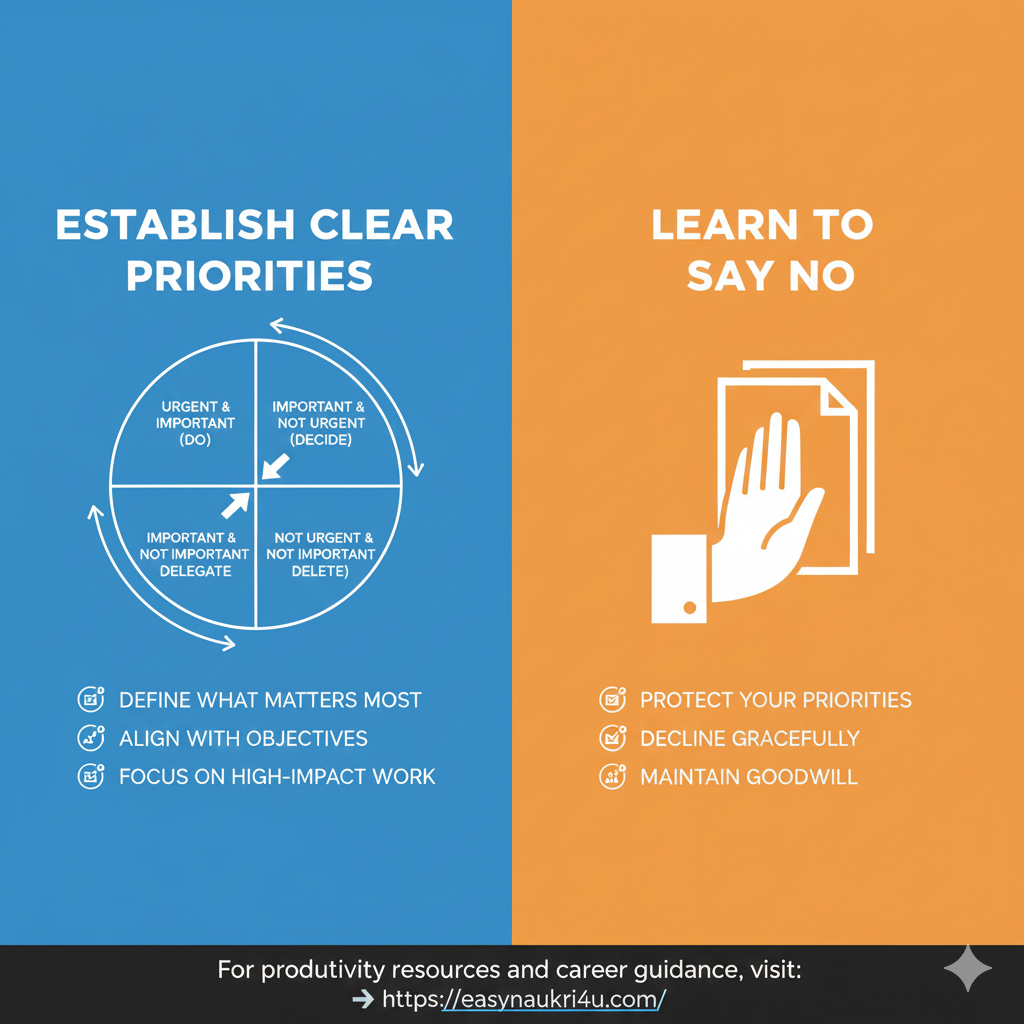
Defining What Matters Most
Effective time management begins with clarity about priorities. Without clear direction, you react to whatever demands attention most loudly rather than focusing on what matters most. This reactive mode produces busyness without meaningful progress.
Identify your most important professional and personal objectives for different time horizons. Annual goals inform quarterly priorities which guide weekly and daily focus. Your time management decisions should consistently align with these defined objectives.
Distinguish between urgent and important activities using frameworks like the Eisenhower Matrix. Many urgent tasks lack true importance while crucial activities rarely demand immediate attention. Strategic prioritization focuses energy on high-impact work.
Learning to Say No
Protecting priorities requires declining requests that would compromise them. Your time management effectiveness depends significantly on what you choose not to do. Every yes to low-priority activities means no to something more important.
Develop comfortable approaches for declining requests without damaging relationships. Polite but firm refusals protect your capacity for meaningful work. Explaining constraints while offering alternatives maintains goodwill while protecting boundaries.
For productivity resources and career guidance, visit:
👉 https://easynaukri4u.com/
2. Planning and Scheduling Strategies
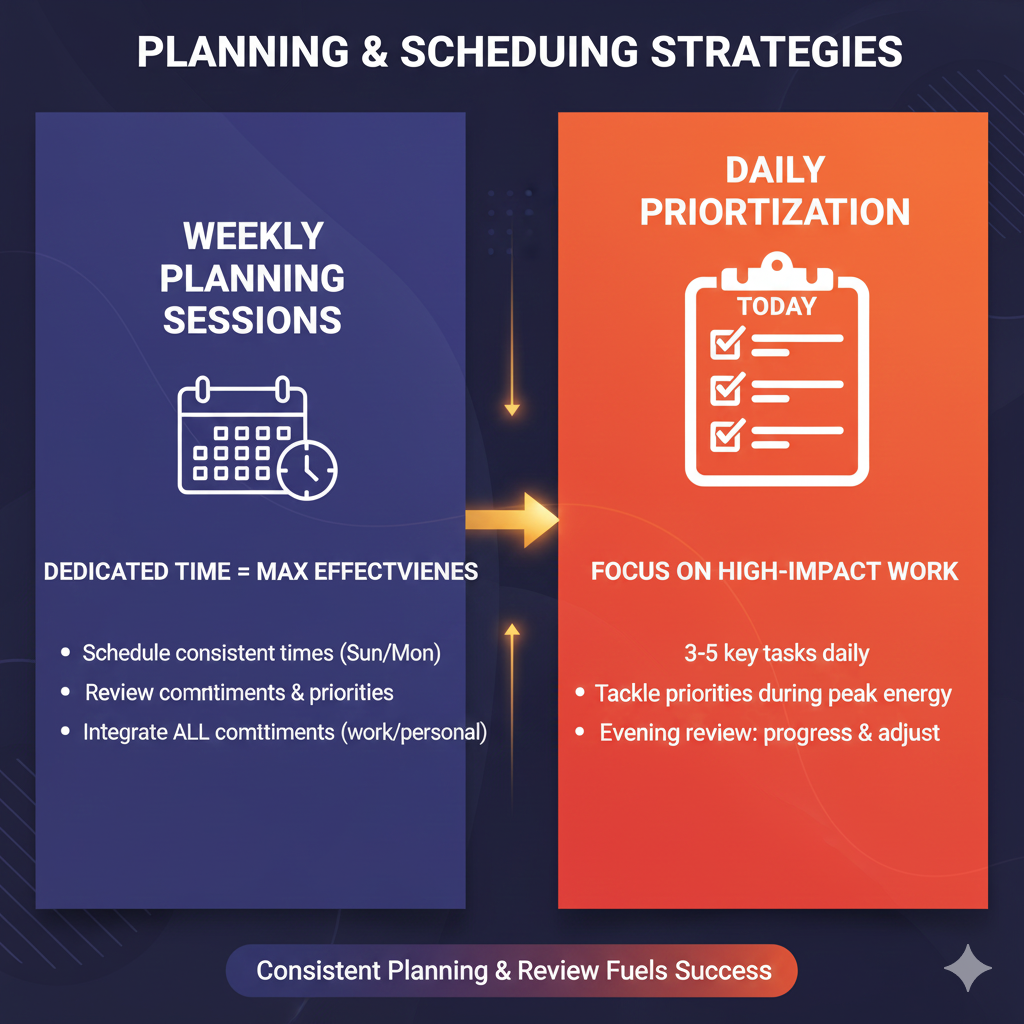
Weekly Planning Sessions
Dedicated planning time dramatically improves time management effectiveness throughout the week. Brief investment in planning prevents hours of wasted effort from poor coordination and missed priorities. This leverage makes planning time exceptionally valuable.
Schedule weekly planning sessions at consistent times, perhaps Sunday evenings or Monday mornings. Review upcoming commitments, align activities with priorities, and identify potential conflicts before they become problems. Your planning ritual sets the week’s trajectory.
Include both professional and personal commitments in weekly planning. Integrated scheduling prevents work from unconsciously consuming time intended for other priorities. Visible personal commitments receive protection they deserve.
Daily Prioritization
Each morning, identify your most important tasks requiring completion that day. Limiting focus to three to five priorities prevents overwhelming lists that paralyze rather than guide. Your time management benefits from clarity about what truly matters today.
Tackle highest-priority items during peak energy periods rather than allowing reactive tasks to consume productive hours. Protecting prime time for important work generates disproportionate results compared to scattered effort throughout the day.
Review progress briefly each evening, noting accomplishments and adjusting plans for tomorrow. This practice provides closure while preparing for the next day’s productivity. Consistent review and adjustment optimizes ongoing effectiveness.
3. Eliminating Time Wasters
Identifying Your Productivity Leaks
Everyone has activities that consume time without proportional value. Your time management improvement requires honestly identifying these productivity leaks. Common culprits include excessive email checking, unnecessary meetings, and social media browsing.
Track your time for at least one week to reveal actual usage patterns. Many professionals are surprised by discrepancies between perceived and actual time allocation. This data provides foundation for meaningful improvement.
Analyze time data to identify activities consuming disproportionate time relative to value produced. These inefficiencies represent opportunities for immediate time management gains without working longer hours.
Managing Digital Distractions
Digital interruptions fragment attention and destroy productivity. Each notification pulls focus from current work, requiring mental energy to re-engage. Your time management must include strategies for controlling digital intrusions.
Disable non-essential notifications across devices during focused work periods. Most messages can wait for designated checking times without negative consequences. Batch processing of communications proves more efficient than constant monitoring.
Use website blockers and app limits to prevent unconscious drifting toward distracting content. Even strong willpower eventually fails against deliberately addictive designs. Technical barriers support your intentions when discipline wavers.
4. The Power of Time Blocking
Understanding Time Blocking
Time blocking involves scheduling specific activities into calendar slots rather than maintaining open-ended task lists. This approach transforms intentions into commitments, significantly improving time management effectiveness. Blocked time receives protection from competing demands.
Assign blocks for different activity types including deep work, meetings, email processing, and personal activities. Varied blocks prevent monotony while ensuring all important categories receive appropriate attention. Balance across activity types sustains long-term productivity.
Respect blocked time as seriously as external appointments. Others’ requests for your time aren’t inherently more important than your own priorities. Treating personal blocks as inviolable commitments protects meaningful work.
Implementing Effective Blocks
Start with blocks for highest-priority activities before filling remaining time with less critical tasks. Your time management should prioritize important work rather than squeezing it around less valuable activities. Priority sequencing ensures focus on what matters most.
Size blocks appropriately for different task types. Creative work benefits from longer uninterrupted blocks while administrative tasks might fit shorter windows. Matching block size to task requirements optimizes productivity.
To explore more productivity strategies and tips, visit:
👉 https://easynaukri4u.com/
5. Managing Energy, Not Just Time
Understanding Energy Patterns
Productivity depends on energy availability as much as time availability. Your time management strategies should account for natural energy fluctuations throughout the day. Working with your biology rather than against it enhances effectiveness dramatically.
Identify your peak energy periods through self-observation. Most people have predictable patterns with morning or afternoon peaks varying by individual. Scheduling demanding work during personal peak times maximizes output quality.
Reserve low-energy periods for routine tasks requiring minimal cognitive effort. Administrative activities, simple communications, and organizing work can occupy energy troughs without significant productivity loss. Matching tasks to energy levels optimizes overall output.
Protecting and Renewing Energy
Sustainable productivity requires energy renewal, not just expenditure. Your time management must include recovery activities that restore capacity for continued performance. Continuous output without renewal leads to diminishing returns and eventual burnout.
Build breaks into your schedule rather than working continuously until exhaustion. Brief recovery periods maintain higher average productivity than powering through without pauses. Strategic breaks represent investments in sustained performance.
Protect sleep as foundational to energy and cognitive function. Sacrificing sleep for additional work hours typically produces net productivity losses through impaired performance. Adequate rest enables sustainable time management success.
6. Meeting Management
Evaluating Meeting Necessity
Meetings consume enormous time in most organizations, often with questionable return. Your time management requires critical evaluation of meeting attendance and participation. Not every meeting invitation deserves acceptance.
Question whether meetings are necessary before accepting or scheduling them. Many matters resolve more efficiently through quick conversations, emails, or collaborative documents. Meetings should address truly collaborative needs rather than defaulting for routine communication.
Decline meetings diplomatically when your presence isn’t essential. Request agendas and contribute asynchronously when possible. Protecting time from unnecessary meetings creates space for higher-value work.
Making Meetings Effective
When meetings are necessary, ensure they produce proportional value. Your time management extends to making attended meetings as efficient as possible. Prepared, focused meetings respect everyone’s time investment.
Arrive prepared with relevant materials reviewed and contributions ready. Unprepared participants waste collective time while reducing meeting value. Personal preparation demonstrates respect for others’ time.
Keep meetings focused and on schedule. Tangential discussions and overrunning meetings multiply time costs across all participants. Firm facilitation protects everyone’s productivity.
7. Delegation and Leverage
Understanding Leverage Opportunities
Effective delegation multiplies your impact by focusing personal effort on highest-value activities. Your time management should include strategic delegation of tasks others can handle appropriately. Attempting everything yourself limits total accomplishment.
Identify activities that must be done by you specifically versus those others could handle. Your unique expertise and authority should focus on activities requiring them specifically. Everything else represents potential delegation opportunity.
Calculate the true cost of not delegating by comparing your hourly value against delegation costs. Often, paying others to handle lower-value tasks frees time for activities generating far greater returns. This leverage creates value beyond direct effort.
Delegating Effectively
Clear communication ensures delegated tasks are completed correctly. Your time management benefits when delegation succeeds without requiring excessive oversight or correction. Investment in clear instructions pays dividends through quality outcomes.
Provide appropriate context, expectations, and deadlines when delegating. Recipients need sufficient information to complete tasks without constant clarification. Complete briefings prevent time-consuming back-and-forth communications.
Follow up appropriately without micromanaging. Trust combined with verification ensures delegation produces intended results while maintaining your confidence in outcomes. Balanced oversight respects others while protecting quality.
8. Handling Procrastination
Understanding Why You Procrastinate
Procrastination undermines even excellent planning and intention. Your time management success requires understanding and addressing procrastination patterns. Different causes require different interventions for effective resolution.
Common procrastination causes include fear of failure, perfectionism, overwhelm, and simple aversion to unpleasant tasks. Identifying which patterns affect you enables targeted solutions rather than generic willpower attempts.
Recognize procrastination triggers and warning signs before hours disappear. Early intervention prevents minor hesitation from expanding into significant delays. Self-awareness enables proactive response.
Overcoming Procrastination Patterns
Break overwhelming tasks into smaller, manageable steps that feel less intimidating. Your time management benefits when large projects become sequences of achievable actions. Progress on small steps builds momentum toward completion.
Use the two-minute rule for quick tasks: if something takes less than two minutes, do it immediately rather than adding it to lists. Immediate action prevents accumulation of small tasks that collectively consume significant time.
Create accountability through commitments to others or public declarations of intentions. External accountability often provides motivation that internal discipline cannot. Leverage social dynamics to overcome procrastination tendencies.
For comprehensive productivity resources, visit:
👉 https://easynaukri4u.com/
9. Technology for Time Management
Productivity Tools and Applications
Numerous applications support effective time management through task management, calendar optimization, and habit tracking. Selecting appropriate tools and using them consistently enhances personal productivity systems.
Task management applications like Todoist, Things, or Asana help organize responsibilities and track progress. Choose tools matching your workflow complexity and personal preferences. Consistent use matters more than specific application selection.
Calendar applications with time-blocking features support scheduled approach to work. Your time management benefits from visual representation of commitments and planned activities. Integrated calendaring keeps all commitments visible.
Avoiding Tool Overload
While technology can help, excessive tool proliferation creates its own inefficiency. Your time management suffers when maintaining multiple systems consumes time better spent on actual work. Simplicity often proves more effective than complexity.
Consolidate tools where possible rather than using separate applications for related functions. Integrated systems reduce friction and maintenance overhead. Fewer, better-utilized tools outperform collections of underused applications.
10. Work-Life Integration
Protecting Personal Time
Sustainable success requires balance between professional achievement and personal fulfillment. Your time management must protect time for relationships, health, and activities beyond work. All work and no play produces diminishing returns and eventual burnout.
Schedule personal commitments with the same seriousness as professional obligations. Family activities, exercise, and social engagements deserve calendar protection. Visible personal blocks receive respect they might otherwise lack.
Establish boundaries preventing work from consuming all available time. Without limits, work expands to fill every moment. Clear boundaries protect personal priorities essential for long-term well-being and sustained professional performance.
Creating Transitions
Clear transitions between work and personal modes improve both. Your time management should include rituals signaling the end of work and beginning of personal time. These transitions enable genuine presence in each domain.
Physical transitions like changing clothes, exercising, or leaving workspace help shift mental modes. When working remotely, deliberate transitions replace natural commute boundaries. Creating these separations intentionally maintains healthy boundaries.
11. Continuous Improvement
Regular Review and Adjustment
Effective time management requires ongoing refinement based on experience and changing circumstances. What worked previously may become less effective as situations evolve. Regular review ensures continued optimization.
Schedule periodic reviews of your productivity systems and outcomes. Weekly or monthly reflection identifies what’s working and what needs adjustment. This continuous improvement mindset sustains long-term effectiveness.
Experiment with new techniques while maintaining proven approaches. Your time management should evolve through tested innovations rather than constant dramatic changes. Gradual refinement produces sustainable improvement.
Learning from Others
Observe how productive people around you manage their time. Your time management can benefit from techniques others have discovered through their own experimentation. Learning from others accelerates personal development.
Read books, articles, and resources on productivity from recognized experts. Curated knowledge from experienced practitioners provides insights beyond personal trial and error. Selective learning enhances your approach efficiently.
12. Common Time Management Mistakes
Multitasking Illusion
Despite widespread belief, multitasking reduces rather than increases productivity. Your time management improves by focusing completely on single tasks rather than dividing attention. Sequential completion outperforms parallel attempts.
Context switching between tasks incurs mental costs that accumulate significantly. Each shift requires reorientation time that fragments focused work. Sustained attention produces better results than scattered effort.
Planning Fallacy
People consistently underestimate time requirements for tasks and projects. Your time management should account for this natural tendency by building buffers into estimates. Realistic expectations prevent cascading schedule problems.
Base estimates on actual past experience rather than optimistic projections. Track how long similar tasks actually took and use this data for future planning. Evidence-based estimation improves accuracy over time.
Perfectionism Traps
Pursuing perfection beyond appropriate quality standards wastes time without proportional value. Your time management benefits from knowing when good enough truly is enough. Diminishing returns make excessive polish inefficient.
Conclusion
Mastering time management creates foundation for both professional success and personal fulfillment. The strategies outlined in this guide provide comprehensive framework for taking control of your schedule and maximizing your impact.
Remember that effective time management requires consistent application and continuous refinement. Knowing techniques without implementing them produces no benefit. Commitment to practice determines actual improvement.
Start improving your productivity today by selecting one or two strategies for immediate implementation. Small, consistent improvements compound into significant transformation over time. Your investment in time management skills pays dividends throughout your career and life.
Take action now by identifying your biggest time challenge and applying relevant techniques from this guide. Each improvement in how you manage time enhances both professional results and personal satisfaction. Your commitment to effective time management shapes the quality of your work and life in 2026 and beyond.
For additional productivity tools and career resources, visit:
👉 https://easynaukri4u.com/