16 Essential Freelancing Tips to Build Successful Career in 2026
BlogIntroduction: Thriving as an Independent Professional

The freelance economy has evolved from alternative work arrangement to mainstream career choice embraced by millions of professionals worldwide seeking autonomy, flexibility, and control over their professional destinies. In 2026, freelancing tips have become essential knowledge for anyone navigating independent work, whether you’re launching full-time freelance careers, supplementing traditional employment with side projects, or transitioning from corporate roles to entrepreneurial ventures. Understanding how to succeed as freelancer can mean the difference between thriving independence and struggling instability.
visit our website – EasyNaukri4U – India’s Leading Government Job Portal
visit our resume builder – Government Jobs - EasyNaukri4U
“According to LinkedIn’s Global Talent Trends Report, recruiters spend an average of six to seven seconds reviewing each resume.”
The modern freelance landscape offers unprecedented opportunities through global marketplaces connecting clients and talent, digital tools enabling remote collaboration, specialized platforms matching skills with demand, and growing organizational acceptance of contingent workers for projects ranging from simple tasks to strategic initiatives. However, these opportunities come with challenges including inconsistent income, constant client acquisition, lack of employer-provided benefits, and need for self-discipline managing all aspects of business operations. freelancing tips
This comprehensive guide presents sixteen essential freelancing tips that address every aspect of successful independent work—from finding clients and setting rates to managing finances and scaling your business. Whether you’re complete beginner considering freelancing or experienced independent professional seeking to level up, these strategies will help you build sustainable, profitable freelance careers that provide both financial success and professional fulfillment aligned with your values and lifestyle preferences.
The most successful freelancers in 2026 treat their work as legitimate businesses requiring strategic planning, professional execution, continuous marketing, and operational excellence rather than casual side hustles or temporary arrangements. By implementing these freelancing tips systematically, you transform from struggling freelancer constantly searching for work into established professional with steady client base, predictable income, and reputation attracting opportunities rather than requiring constant pursuit. freelancing tips
For freelancing resources and opportunities, visit: 👉 https://easynaukri4u.com/
Understanding the Freelance Landscape in 2026

The Evolution of Independent Work
Freelancing tips for 2026 must account for how dramatically the independent work landscape has evolved. What began as primarily creative and technical contractors has expanded to include professionals across virtually all industries and specializations. Remote work normalization has eliminated geographic constraints, enabling freelancers to serve clients globally. Platform economies have created structured marketplaces reducing friction in finding work. And organizational shift toward flexible workforces has increased demand for skilled independent professionals.
The distinction between traditional employment and freelancing has blurred with hybrid arrangements, fractional executives, portfolio careers combining multiple clients, and professionals moving fluidly between employment and independence throughout careers. This evolution means freelancing no longer represents career risk or stepping stone but rather viable long-term professional path offering advantages traditional employment cannot match.
Why Freelancing Appeals to Modern Professionals
Professionals choose freelancing for varied reasons that effective freelancing tips must address. Autonomy and control over work choices, schedules, and career direction attract those frustrated by corporate constraints. Income potential often exceeds employment salaries once freelancers establish themselves and command premium rates. Flexibility supporting family commitments, travel, or personal interests appeals to those prioritizing work-life integration. Variety across clients and projects prevents boredom while building diverse experience.
Additionally, freelancing offers protection against single-employer dependence, with diversified client base providing more security than relying on one employer who could eliminate your position. The ability to design your ideal work life rather than accepting employer-dictated arrangements represents powerful draw for professionals seeking alignment between work and personal values.
Common Freelancing Challenges
Understanding challenges freelancers face helps you prepare with appropriate freelancing tips. Income inconsistency creates financial stress without steady paychecks. Constant client acquisition requires ongoing marketing rather than focusing purely on service delivery. Lack of employer benefits means managing your own healthcare, retirement, and insurance. Self-discipline becomes critical without external accountability. Isolation can affect those who thrive on workplace social interaction. And administrative burden of running business—invoicing, taxes, contracts—consumes time beyond billable work.
However, these challenges are manageable with proper planning, systems, and strategies. The freelancing tips in this guide directly address these common obstacles, providing proven approaches for building sustainable independent careers. freelancing tips
16 Essential Freelancing Tips

1. Start With Clear Niche and Positioning
The foundation of successful freelancing is clear positioning in specific niche rather than being generalist offering everything to everyone. Specialists command higher rates, face less competition, attract better clients, and build stronger reputations than generalists. Among the most important freelancing tips is identifying your specialty—the specific services you offer to specific target clients solving particular problems.
Your niche should balance your skills and interests with market demand and profitability. Too broad makes you indistinguishable from thousands of competitors. Too narrow limits opportunity. Find the sweet spot where your expertise meets sufficient demand for sustainable business while remaining focused enough to differentiate yourself.
Niche Selection Criteria:
- Aligns with your skills and experience
- Addresses real market need with paying clients
- Sufficient demand to sustain your business
- Not so saturated you can’t differentiate
- Genuinely interests you for long-term sustainability
- Allows premium pricing for specialized expertise
- Enables building deep expertise over time
Positioning Statement:
Develop clear positioning: “I help [target clients] achieve [specific outcome] through [your approach/service].”
Examples:
- “I help SaaS startups create conversion-optimized landing pages that turn visitors into paying customers”
- “I provide CFO-level financial strategy for growing e-commerce businesses not ready for full-time finance executives”
- “I write technical documentation that helps software companies reduce support tickets while improving user experience”
Testing Your Niche:
Validate your niche by researching competition (some competition is good—proves market exists), talking to potential clients about their needs and willingness to pay, and testing services with initial clients before committing fully. Adjust based on what you learn.
2. Build Professional Portfolio and Online Presence

Among critical freelancing tips for attracting clients is creating compelling portfolio showcasing your best work, demonstrating capabilities, and building credibility. Your portfolio provides tangible evidence of your skills while helping potential clients envision working with you. Combined with strong online presence, portfolio becomes your primary marketing asset working 24/7 attracting opportunities.
Your portfolio should include your best work samples, case studies showing process and results, client testimonials and recommendations, clear descriptions of services offered, your unique approach or methodology, contact information and call-to-action, and professional presentation reflecting quality clients can expect. freelancing tips
Portfolio Essentials:
- 5-10 strong work samples (quality over quantity)
- Case studies with context, challenges, solutions, results
- Client testimonials and recommendations
- Clear service descriptions and pricing (if appropriate)
- Professional biography and credentials
- Easy navigation and mobile compatibility
- Regular updates showing current work
Platform Options:
- Personal website with portfolio (most professional)
- Behance or Dribbble for creative work
- GitHub for developers
- Medium or personal blog for writers
- LinkedIn featured section
- Platform-specific profiles (Upwork, Fiverr, Toptal)
Portfolio When Starting:
New freelancers without client work can create portfolio through spec projects, volunteer work for nonprofits, personal projects demonstrating skills, reimagining existing brands or products, or offering discounted initial projects specifically for portfolio building. Never claim client work you didn’t do, but you can demonstrate skills through various projects. freelancing tips
Online Presence Beyond Portfolio:
Maintain professional presence on LinkedIn, relevant social media, freelance platforms, and professional directories. Consistent online visibility helps clients find you while building credibility through professional presentation across platforms.
For portfolio development resources and templates, explore: 👉 https://easynaukri4u.com/
3. Master Client Acquisition Strategies

Consistent client acquisition represents perhaps the most challenging aspect of freelancing, making this one of the most crucial freelancing tips to master. Successful freelancers develop multiple client acquisition channels rather than relying on single approach, creating sustainable pipeline ensuring you’re never desperate for work. Diversification across acquisition channels provides stability and leverage. freelancing tips
Different acquisition strategies work for different freelancers and niches. Experiment with various approaches, measure results, and double down on what works for your specific situation while maintaining presence in multiple channels for security.
Client Acquisition Channels:
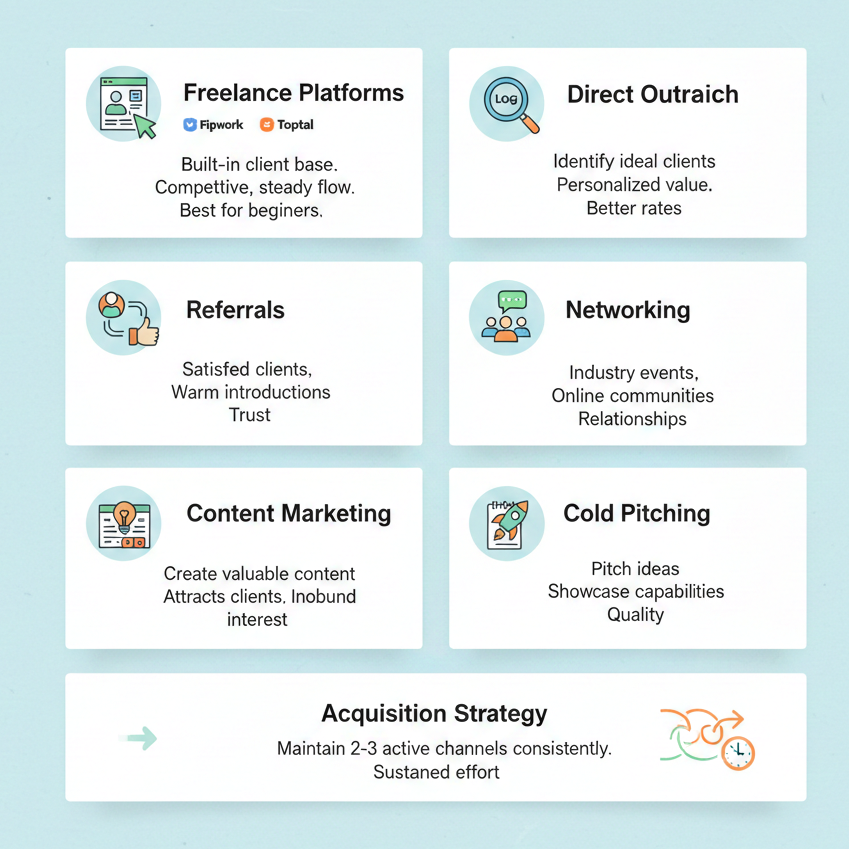
Freelance Platforms:
Upwork, Fiverr, Freelancer, Toptal, and specialized platforms provide built-in client bases. They’re competitive but offer steady opportunity flow for those who optimize profiles and proposals. Best for beginners building experience and portfolio.
Direct Outreach:
Identify ideal clients and reach out directly offering value. Research companies needing your services, personalize outreach demonstrating understanding of their needs, and follow up persistently but professionally. Higher effort but often better quality clients and rates.
Referrals:
Ask satisfied clients for referrals and testimonials. Offer referral incentives when appropriate. The best clients often come through warm introductions from existing clients who trust you and can vouch for your work.
Networking:
Attend industry events, join professional associations, participate in online communities, and build genuine relationships leading to client opportunities. Networking provides both direct client connections and referral sources.
Content Marketing:
Create valuable content demonstrating expertise—blog posts, videos, social media, speaking—that attracts potential clients searching for solutions you provide. Slower to build but creates inbound interest reducing active selling.
Cold Pitching:
For writers and creatives, pitch ideas to publications, agencies, or companies you want to work with. Demonstrate understanding of their needs while showcasing your capabilities through pitch quality.
Acquisition Strategy:
Maintain 2-3 active client acquisition channels consistently rather than switching focus based on immediate results. Client acquisition requires sustained effort before producing results, so give strategies time to work before abandoning them.
4. Set Rates That Reflect Your Value
Pricing represents critical freelancing tips area where many freelancers undervalue themselves, leaving money on table while establishing unsustainable rate expectations. Research market rates for your services and experience level, calculate your costs and desired income, factor in non-billable time (administration, marketing, learning), and price based on value delivered rather than hours worked when possible.
As you gain experience, regularly increase rates reflecting growing expertise and proven results. Grandfathering existing clients at old rates while charging new clients current rates is common practice. Remember that premium pricing often attracts better clients who value quality over cheap rates. freelancing tips
Pricing Models:
Hourly Rates:
Simple and flexible but caps earning potential and penalizes efficiency. Common for ongoing support or uncertain scope projects.
Project-Based:
Fixed price for defined deliverables. Rewards efficiency and makes budgeting easier for clients. Requires accurate scope estimation to remain profitable.
Value-Based:
Price based on value delivered to client rather than time invested. Highest earning potential but requires understanding client economics and strong positioning. Works best when you can quantify impact. freelancing tips
Retainer:
Monthly fee for guaranteed availability or ongoing services. Provides income predictability for freelancer and priority access for client. Ideal for long-term relationships.
Rate Calculation:
Calculate minimum viable rate covering expenses, taxes, benefits, and desired profit margin. Factor in that you won’t bill 40 hours weekly due to administrative work, marketing, and gaps between projects. Many freelancers target billing 20-25 hours weekly, meaning hourly rate must reflect this reality.
Rate Increases:
Plan annual rate increases for new clients while occasionally raising rates for existing clients (with advance notice and justification). Communicate value continuously so rate increases feel justified rather than arbitrary.
5. Create Solid Contracts and Agreements
Professional contracts protect both you and clients while setting clear expectations preventing misunderstandings. Among essential freelancing tips is never working without written agreements covering scope, deliverables, timeline, payment terms, revision process, and ownership rights. Contracts don’t need to be complex legal documents but should clearly define the relationship and terms. freelancing tips
Standard contract elements include detailed scope of work, specific deliverables, project timeline and milestones, payment amount and schedule, revision policy and limits, cancellation and refund terms, ownership and usage rights, confidentiality provisions, and liability limitations. freelancing tips
Contract Essentials:
- Detailed scope preventing scope creep
- Clear deliverables and acceptance criteria
- Timeline with key milestones
- Payment terms (amount, schedule, method)
- Revision policy (number included, fees for additional)
- Cancellation terms for both parties
- Intellectual property and ownership rights
- Confidentiality when appropriate
- Liability limitations
- Dispute resolution process
Payment Terms:
Structure payment protecting your interests: deposits before starting (25-50% common), milestone payments for larger projects, final payment upon completion, and late payment penalties. Never complete all work before receiving substantial payment—clients who haven’t paid have little incentive to do so after receiving completed work. freelancing tips
Contract Resources:
Use contract templates customized for your services and jurisdiction. Have attorney review your standard contract ensuring it provides appropriate protection. Investment in solid contract template pays for itself preventing future disputes.
When Contracts Aren’t Possible:
Some platforms or small projects may not accommodate formal contracts. At minimum, have written agreement via email clearly stating terms. This email confirmation provides some protection if disputes arise. freelancing tips
For contract templates and legal resources, visit: 👉 https://easynaukri4u.com/
6. Manage Your Time and Productivity Effectively
Freelancing success requires excellent time management and productivity since you’re responsible for all aspects of business without managers providing structure. Key freelancing tips for productivity include establishing regular work schedules even with flexibility, using time tracking understanding where hours go, batching similar tasks for efficiency, minimizing distractions during work time, and taking breaks preventing burnout. freelancing tips
Balance client work with essential business activities like marketing, administrative tasks, and professional development. Many freelancers fail because they focus exclusively on client work, neglecting marketing until projects end and they have no pipeline. Dedicate specific time to business development regardless of current workload.
Productivity Strategies:
Structured Schedule:
Create consistent work schedule even if hours are flexible. Having routine makes it easier to maintain discipline and separate work from personal time. Block specific times for different activities—client work, marketing, administration. freelancing tips
Time Tracking:
Track all time including billable client work and non-billable business activities. This reveals whether you’re spending time productively and whether your rates cover actual hours invested in business. Tools like Toggl, Harvest, or Clockify simplify tracking.
Task Batching:
Group similar tasks together—invoicing, email, content creation, client communication—handling them in dedicated blocks rather than switching contexts constantly. Batching improves focus and efficiency.
Distraction Management:
Eliminate distractions during work time: close unrelated browser tabs, silence notifications, use focus apps blocking distracting websites, work in dedicated space, communicate boundaries to family or housemates. freelancing tips
Energy Management:
Schedule demanding work during peak energy times, save routine tasks for low-energy periods, and take regular breaks maintaining focus. Working exhausted wastes time producing poor quality work.
Saying No:
Protect your time by declining projects outside your niche, below your rates, with unrealistic timelines, or from difficult clients. Every yes to wrong opportunity is no to better ones that might arise.
7. Build Systems and Automate Repetitive Tasks
Scalable freelancing requires systems and automation handling repetitive tasks efficiently, among important freelancing tips for growing beyond solo practitioner trading hours for money. Document your processes, create templates for common communications and deliverables, automate scheduling and invoicing, and build systems enabling consistent quality without reinventing approaches for each client.
Systems don’t mean robotic impersonal service—they create consistency and efficiency for routine elements while freeing time for high-value creative and strategic work requiring your unique expertise. Well-designed systems allow you to take on more clients or raise rates while maintaining quality and preventing burnout.
Systems to Develop:
Client Onboarding:
Standardized process for new clients: welcome email, contract sending, information gathering, project kickoff. Templates and automation reduce administrative burden while ensuring nothing falls through cracks.
Project Management:
Consistent approach to project execution: initial research, drafts or prototypes, revision cycles, delivery, and follow-up. Process ensures quality while making timeline estimation more accurate.
Communication:
Templates for common communications: proposals, contracts, status updates, delay notifications, completion notices. Customize for each client but start from proven templates rather than writing from scratch.
Invoicing and Payment:
Automated invoicing on schedule, payment reminders for late payments, and organized financial records. Tools like FreshBooks, Wave, or QuickBooks automate much of this.
Portfolio Updates:
Regular schedule reviewing recent work, gathering testimonials, and updating portfolio. Don’t let portfolio become outdated representing past capabilities rather than current expertise.
Tools for Systems:
Project management (Asana, Trello, ClickUp), communication (templates in Gmail, Notion), scheduling (Calendly, Acuity), contracts (HelloSign, DocuSign), invoicing (FreshBooks, Wave), and accounting (QuickBooks, Wave).
8. Deliver Exceptional Quality and Customer Service
Your reputation determines long-term freelancing success, making quality and service critical freelancing tips for building sustainable business. Exceed client expectations through exceptional work quality, clear communication, meeting deadlines reliably, being responsive to questions and concerns, and being pleasant to work with. Happy clients provide referrals, testimonials, and repeat business—the foundation of sustainable freelancing.
Remember that clients hire you to solve problems and make their lives easier, not create additional stress. Professional, reliable, quality service differentiates you from countless competitors and justifies premium rates. Your reputation builds slowly through consistent excellence but can be damaged quickly through poor work or unprofessional behavior.
Quality Delivery:
- Understand requirements thoroughly before starting
- Communicate proactively about progress and any issues
- Meet deadlines or communicate early if delays occur
- Exceed expectations when possible
- Request feedback and incorporate it professionally
- Handle revisions gracefully within agreed terms
- Follow through on commitments consistently
Client Communication:
- Respond to inquiries within 24 hours
- Provide regular project updates
- Ask clarifying questions preventing assumptions
- Set and manage realistic expectations
- Be honest about capabilities and limitations
- Communicate problems early with solutions
- Make working with you easy and pleasant
Professionalism:
Maintain professional boundaries, avoid overpromising, handle criticism constructively, admit and correct mistakes, maintain confidentiality, and treat all clients with respect regardless of project size. Professional reputation spreads—people talk about both exceptional and poor experiences.
Going Above and Beyond:
Small gestures create loyalty: delivering early, including bonus elements, providing helpful resources, making thoughtful suggestions improving their business, or simply being genuinely invested in their success. These extras cost little but generate significant goodwill.
For client management resources and communication templates, explore: 👉 https://easynaukri4u.com/
9. Manage Finances and Plan for Irregular Income
Financial management represents crucial freelancing tips since irregular income creates different challenges than regular paychecks. Build emergency fund covering 3-6 months expenses, separate business and personal finances, set aside money for taxes quarterly, track all income and expenses, create budgets based on variable income, and plan for lean periods following flush months.
Understanding your financial runway—how long you can operate without new income—reduces stress during slow periods while informing decisions about rate minimums and project acceptance. Financial discipline enables sustainable freelancing rather than perpetual financial stress undermining your work and wellbeing.
Financial Management:
Emergency Fund:
Build and maintain emergency fund covering several months of expenses. This provides cushion during slow periods and enables turning down poor-fit projects without desperation.
Separate Accounts:
Maintain separate business and personal bank accounts simplifying bookkeeping, clarifying business performance, and providing professionalism. Consider business credit card for business expenses.
Tax Planning:
Set aside 25-30% of income for taxes, make quarterly estimated tax payments, track deductible business expenses, and consult tax professional familiar with self-employment. Tax surprises can devastate freelancers unprepared for obligations.
Expense Tracking:
Record all business expenses for tax deductions and understanding true profitability. Common deductions include home office, equipment, software subscriptions, professional development, business travel, and health insurance.
Variable Income Budgeting:
Average your income over several months for budgeting rather than budgeting based on individual months. Save excess from good months covering shortfalls in slow periods.
Retirement Planning:
Without employer 401(k) matching, take responsibility for retirement savings through SEP IRA, Solo 401(k), or traditional/Roth IRA. Start early taking advantage of compound growth.
Insurance:
Obtain health insurance through marketplace, spouse, or professional associations. Consider disability insurance protecting income if you cannot work and professional liability insurance if relevant to your services.
10. Develop Multiple Revenue Streams
While client services form your core income, diversifying revenue streams provides stability and scalability—important freelancing tips for long-term success. Additional streams might include productized services, digital products, courses or coaching, affiliate marketing, passive income from content, or retainer clients providing predictable monthly income.
Multiple streams reduce dependence on constant client acquisition while creating income during service delivery gaps. Some streams provide passive income requiring upfront effort but generating ongoing revenue with minimal maintenance. Balance new stream development with maintaining service quality for core clients.
Revenue Stream Options:
Retainer Clients:
Convert project clients to ongoing monthly retainers providing guaranteed income while giving clients priority access. Retainers smooth income variability.
Productized Services:
Package services as standardized offerings with fixed scope and pricing. Easier to market and deliver efficiently than custom projects while still leveraging your expertise.
Digital Products:
Create templates, tools, resources, or guides selling repeatedly without additional delivery time. Higher upfront effort but scalable income potential.
Online Courses:
Package expertise into courses selling on platforms like Teachable or Udemy. Passive income once created, though marketing and updates required.
Affiliate Marketing:
Recommend tools and services you genuinely use, earning commissions on resulting sales. Works well alongside content marketing.
Consulting or Coaching:
Offer higher-priced strategic consulting or coaching leveraging expertise without hands-on delivery. Often allows premium hourly rates.
Content Monetization:
Monetize blog, YouTube channel, or podcast through ads, sponsorships, or premium content once you build sufficient audience.
Strategic Diversification:
Add streams gradually after establishing core business rather than splitting focus too early. Ensure new streams align with brand and serve same target audience when possible.
11. Build Long-Term Client Relationships
Acquiring new clients costs significantly more in time and effort than retaining existing ones, making relationship building essential freelancing tips for sustainable business. Focus on converting one-time projects into ongoing relationships through excellent work, staying in touch between projects, providing continued value, and making it easy for clients to return for additional work.
Long-term clients provide predictable income, reduce marketing burden, often pay higher rates due to established trust, provide referrals to similar clients, and create efficiencies as you learn their preferences and processes. A few strong ongoing relationships often generate more income with less stress than constant new client acquisition.
Relationship Building:
- Exceed expectations on initial projects
- Stay in touch via occasional helpful emails
- Share relevant resources or information
- Check in periodically without selling
- Celebrate their successes
- Remember details about their business and preferences
- Make working together easy and pleasant
- Ask for feedback and implement suggestions
Repeat Business Strategies:
- Plant seeds for future work during current projects
- Suggest logical next projects addressing their needs
- Offer retainer or ongoing support arrangements
- Provide exceptional service making you indispensable
- Respond quickly when they reach out
- Maintain institutional knowledge about their business
- Proactively identify opportunities to help
Client Lifetime Value:
Consider lifetime value of client relationships when making decisions about pricing, service delivery, and effort invested. Small compromise on single project may preserve relationship generating far more value over time.
Graceful Endings:
When relationships end, part professionally maintaining doors open for future reconnection or referrals. Don’t burn bridges even if you’re frustrated—professional communities are smaller than they appear.
For client retention strategies and templates, visit: 👉 https://easynaukri4u.com/
12. Continuously Market Your Services
Marketing never ends in successful freelancing—among the most critical freelancing tips is maintaining consistent marketing even when fully booked. Pipeline building takes time, so marketing during slow periods means you’re already behind. Dedicate specific weekly time to marketing regardless of current workload, creating steady opportunity flow preventing feast-famine cycles.
Marketing doesn’t require expensive campaigns—consistent presence, valuable content, relationship nurturing, and strategic visibility in the right places often outperform paid advertising. Focus on sustainable marketing activities you can maintain long-term rather than intensive bursts followed by silence.
Sustainable Marketing Activities:
Content Creation:
Regular blog posts, social media updates, videos, or podcasts demonstrating expertise while providing value. Attracts potential clients searching for solutions you provide.
Social Media Presence:
Active presence on platforms where your target clients engage. Share insights, participate in discussions, and build visibility through helpful engagement.
Networking:
Ongoing relationship building through events, online communities, professional associations, and one-on-one connections. Warm relationships generate more opportunities than cold outreach.
Past Client Outreach:
Regular check-ins with past clients maintaining relationships and uncovering new project needs. Former clients represent your warmest leads.
Referral Requests:
Systematically request referrals from satisfied clients. Make it easy by suggesting specific types of contacts they might know who need your services.
Strategic Partnerships:
Build relationships with complementary service providers who serve same clients but don’t compete directly. Mutual referrals benefit both parties.
Speaking and Teaching:
Speaking at events, teaching workshops, or guest appearing on podcasts builds authority while introducing you to potential clients.
Marketing Calendar:
Schedule specific marketing activities weekly ensuring consistent effort. Batch similar activities—content creation, outreach, social media—for efficiency.
13. Set Boundaries and Avoid Burnout
Freelancing flexibility can become trap where work invades all personal time without boundaries protecting wellbeing. Important freelancing tips include setting work hours, taking time off, declining projects when overloaded, communicating availability clearly, and maintaining life outside work. Burnout destroys productivity, creativity, and ultimately your business if not managed.
Remember that sustainable business serves your life rather than consuming it. Financial success without wellbeing and relationships represents hollow achievement. Protect what matters through intentional boundaries and self-care practices supporting long-term freelancing success.
Boundary Setting:
Work Hours:
Establish regular work schedule even with flexibility. Communicate these hours to clients and honor them yourself. After-hours work should be exception, not norm.
Vacation and Time Off:
Schedule regular time off, communicating unavailability to clients in advance. Truly disconnect rather than working from vacation, allowing genuine rest and renewal.
Workload Management:
Know your capacity and decline additional work when at limits. Overcommitting damages quality and client relationships while causing stress.
Client Boundaries:
Set expectations about response times, revision limits, and communication methods. Train clients to respect boundaries through consistent enforcement.
Scope Protection:
Prevent scope creep by clearly defining project parameters and requiring change orders for additional work. Saying no to scope creep protects both profitability and sanity.
Burnout Prevention:
- Take regular breaks during work days
- Maintain hobbies and interests outside work
- Exercise and maintain physical health
- Nurture relationships and social connections
- Set and protect non-work time
- Monitor stress and adjust workload accordingly
- Seek support when struggling
Self-Care Investment:
View self-care not as luxury but as business necessity. Well-rested, healthy, balanced freelancers produce better work and maintain careers long-term.
14. Invest in Professional Development
Continuously developing skills keeps you competitive and enables rate increases—critical freelancing tips for long-term success. Markets evolve, technologies change, and client needs shift. Freelancers who stagnate find themselves competing on price with newer professionals rather than commanding premium rates for current expertise.
Allocate budget and time to learning new skills, staying current in your field, obtaining relevant certifications, attending conferences or workshops, and generally investing in your capabilities. This investment pays dividends through expanded service offerings, higher rates, better clients, and career longevity.
Professional Development:
- Online courses expanding capabilities
- Industry conferences and events
- Professional certifications when relevant
- Books and publications in your field
- Webinars and workshops
- Mastermind groups with peers
- Coaching or mentorship
- Experimentation with new tools and techniques
Learning Budget:
Allocate percentage of revenue (3-5% common) to professional development. This investment compounds as improved capabilities enable higher rates and better opportunities.
Applying Learning:
Don’t just accumulate knowledge—apply it to client work, share it with your audience, and use it to expand service offerings. Learning without application provides no ROI.
Teaching What You Learn:
Teaching others what you’re learning reinforces your understanding while building authority. Share insights through content, speak about new developments, or mentor others in your field.
15. Plan for Scaling Beyond Solo Practice
As your freelance business matures, consider scaling strategies moving beyond trading hours for money. Freelancing tips for growth include raising rates as demand exceeds capacity, productizing services for efficient delivery, outsourcing or subcontracting overflow work, creating passive income streams, hiring team members, or transitioning to agency model.
Not all freelancers want to scale significantly—remaining solo practitioner with selective clients and premium rates is perfectly valid choice. However, understanding growth options helps you make intentional decisions about your business trajectory rather than defaulting to remaining solo because you don’t see alternatives.
Scaling Strategies:
Premium Pricing:
Raise rates until demand matches desired capacity. This “scales” income without increasing hours worked or team size.
Productized Services:
Package expertise as standardized deliverables with fixed scope and pricing, enabling efficient delivery at scale with consistent quality.
Subcontracting:
Partner with other freelancers handling overflow work or complementary services. You maintain client relationships while delegating delivery.
Team Building:
Hire employees or contractors helping deliver services, allowing you to take on more volume or larger projects beyond solo capacity.
Agency Model:
Transition from solo freelancer to agency owner managing team, focusing on business development and account management while team delivers work.
Passive Income:
Develop digital products, courses, or other passive revenue streams supplementing or eventually replacing active client services.
Strategic Decisions:
Scaling requires different skills—team management, business operations, sales—than service delivery. Consider whether you want to scale, what model aligns with your goals, and whether you’re willing to develop business ownership skills beyond your craft.
For business growth resources and scaling strategies, explore: 👉 https://easynaukri4u.com/
16. Build Resilience and Adaptability
Freelancing includes inevitable challenges—difficult clients, payment issues, dry spells, project failures, market changes. Final essential freelancing tips involve building resilience handling setbacks, maintaining perspective during challenges, learning from failures, adapting to market changes, and developing mental toughness sustaining you through freelancing’s ups and downs.
Long-term freelancing success requires not just skills and systems but also psychological resilience bouncing back from disappointments while maintaining confidence and optimism driving continued effort. Develop support systems, maintain healthy perspective, practice self-compassion, and recognize that challenges are normal rather than signs you’re failing.
Building Resilience:
Financial Cushion:
Emergency fund provides psychological security as much as financial protection, reducing stress during slow periods.
Support Network:
Connect with other freelancers understanding unique challenges, join communities providing support and advice, and maintain relationships with friends and family offering perspective beyond work.
Realistic Expectations:
Understand that all freelancers experience rejection, difficult clients, slow periods, and setbacks. These are normal, not personal failures.
Learning Mindset:
View challenges as learning opportunities rather than pure failures. Each difficulty teaches lessons improving future performance.
Self-Compassion:
Practice kindness toward yourself during struggles rather than harsh self-criticism that undermines confidence and motivation.
Perspective Maintenance:
Remember your bigger why beyond specific projects or clients. Short-term setbacks don’t determine long-term trajectory.
Adaptability:
Markets change, platforms evolve, client needs shift. Successful freelancers adapt rather than rigidly clinging to approaches that no longer work.
Stress Management:
Develop healthy coping mechanisms for stress—exercise, meditation, hobbies, social connection—preventing unhealthy responses that damage wellbeing and business.
Common Freelancing Mistakes to Avoid
Underpricing Your Services
Perhaps the most common and damaging freelancing mistake is charging too little, either from insecurity about your value or desperation for work. Underpricing attracts price-sensitive clients focused on cost over quality, makes business financially unsustainable, positions you as cheap option rather than quality provider, and makes rate increases difficult once established. Price competitively based on value delivered, not desperately based on fear.
Neglecting Contracts and Agreements
Working without proper contracts invites misunderstandings, scope creep, payment disputes, and exploitation. Never begin work without written agreement covering essential terms. The time investment creating contracts prevents far larger time investments resolving disputes later.
Overcommitting and Poor Time Management
Saying yes to everything creates overwhelm, damages work quality, causes missed deadlines, and leads to burnout. Know your capacity, maintain realistic schedules, and decline work when you’re at limits. Better to deliver exceptional work to fewer clients than mediocre work to too many.
Inconsistent Marketing
Marketing only when desperate for work creates feast-famine cycles that stress finances and force accepting poor-fit clients. Maintain consistent marketing regardless of current workload building sustainable opportunity pipeline.
Ignoring Business Operations
Treating freelancing as casual side work rather than legitimate business leads to financial chaos, legal problems, tax issues, and unprofessional operations. Take business aspects seriously—proper bookkeeping, tax compliance, legal protection, and professional systems.
Industry-Specific Freelancing Considerations
Creative Freelancing
Writers, designers, photographers, and video creators face particular challenges including subjective work evaluation, client revision requests, intellectual property concerns, and portfolio requirements. Focus on clear creative briefs, revision policies in contracts, building strong portfolios, and diversifying income through stock content, courses, or products alongside client work.
Technical Freelancing
Developers, engineers, and technical consultants command premium rates but face rapidly evolving technology requiring continuous learning. Specialize in specific technologies or industries, maintain current technical skills, contribute to open source for visibility, and consider productized technical services for scalability.
Consulting and Strategy
Business consultants, strategists, and advisors sell expertise rather than hands-on delivery. Build authority through thought leadership content, demonstrate results through case studies and testimonials, network extensively in target industries, and structure engagements around value delivered rather than time invested.
Service-Based Freelancing
Virtual assistants, bookkeepers, customer service providers, and administrative professionals often compete on price. Differentiate through specialization (specific industries, software, or services), premium service quality, packaged service offerings, or building long-term retainer relationships providing stability.
Conclusion: Building Your Successful Freelance Career
Successful freelancing in 2026 combines specialized expertise with business acumen, strategic marketing with excellent delivery, proper systems with personal resilience, and professional excellence with healthy boundaries. The sixteen freelancing tips presented in this guide—from niche positioning and professional portfolios to financial management and scaling strategies—provide comprehensive framework for building sustainable, profitable independent careers offering both financial success and professional fulfillment.
Remember that freelancing success is marathon, not sprint. Building sustainable business takes time, patience, persistence through challenges, continuous learning, and ongoing refinement of your approach. Don’t expect overnight success, but do expect that consistent professional execution of these freelancing tips will create increasing opportunities, income, and satisfaction over time.
Start strengthening your freelance business today by implementing 2-3 tips from this guide that address your biggest current challenges. Whether that means clarifying your niche, building your portfolio, establishing better contracts, raising your rates, or developing sustainable marketing practices, focused improvement in key areas compounds into significant business growth.
The freedom, flexibility, and fulfillment that successful freelancing provides is worth the effort required to build sustainable business. By treating your freelancing professionally, continuously developing your capabilities, delivering exceptional value, and implementing proven strategies, you create independent career supporting not just financial goals but overall life satisfaction.
Take action now by identifying one aspect of your freelancing needing immediate attention and committing to meaningful improvement over the next 30 days. Whether launching your freelance business, stabilizing inconsistent income, attracting better clients, or scaling beyond solo practice, forward movement through these freelancing tips creates the successful independent career you envision.
For comprehensive freelancing resources, community support, client opportunities, and ongoing guidance helping you build thriving independent business, visit: 👉 https://easynaukri4u.com/
Your successful freelance career is within reach through strategic planning, professional execution, continuous improvement, and persistent effort applying these proven freelancing tips. Start building the independent business and lifestyle you want today—your future freelancing success begins with the actions you take now.