14 Essential Work-Life Balance Tips for Professionals in 2026
BlogIntroduction: Redefining Success in the Modern Workplace

Achieving meaningful work-life balance has become one of the most challenging yet essential pursuits for modern professionals navigating increasingly demanding careers, constant digital connectivity, and blurred boundaries between work and personal time. In 2026, the traditional notion of balance as perfect equilibrium between work and life has evolved into more nuanced understanding of integration, boundaries, and intentional choices that align with individual values and circumstances rather than one-size-fits-all formulas.
visit our website – EasyNaukri4U – India’s Leading Government Job Portal
visit our resume builder – Government Jobs - EasyNaukri4U
“According to LinkedIn’s Global Talent Trends Report, recruiters spend an average of six to seven seconds reviewing each resume.”
The importance of work-life balance extends far beyond feel-good wellness rhetoric—it directly impacts your physical health, mental wellbeing, relationship quality, job performance, career longevity, and overall life satisfaction. Professionals who successfully navigate this balance report higher job satisfaction, lower burnout rates, better physical health, stronger relationships, and ironically, often greater career success than those who sacrifice everything for work advancement.
This comprehensive guide presents fourteen essential work-life balance strategies that work in real-world professional environments where deadlines matter, ambition drives behavior, and career success remains important alongside personal fulfillment. These aren’t idealistic suggestions requiring career abandonment or dramatic life overhauls, but rather practical, implementable approaches that help you create sustainable balance supporting both professional achievement and personal wellbeing.
The most successful approaches to work-life balance in 2026 acknowledge that perfect balance rarely exists—some periods require more work focus while others allow more personal time. The goal isn’t achieving constant equilibrium but rather maintaining overall balance across time, setting boundaries protecting what matters most, and making intentional choices aligned with your values rather than defaulting to work consuming all available time and energy.
For career wellness resources and opportunities, visit: 👉 https://easynaukri4u.com/
Understanding Work-Life Balance in 2026

The Evolution of Work-Life Integration
The concept of work-life balance has shifted from rigid separation between work and personal life to more flexible integration acknowledging that modern technology, remote work, and changing professional norms make absolute separation unrealistic for many careers. Work-life integration recognizes that sometimes checking email in the evening enables leaving work earlier for family commitments, or that working from home allows attending children’s school events while still meeting professional obligations.
However, integration doesn’t mean work invading all personal time. It means intentionally choosing when and how work and life blend rather than defaulting to constant availability and work always taking priority. Effective work-life balance in 2026 requires setting clear boundaries while maintaining flexibility for inevitable exceptions.
Why Work-Life Balance Matters More Than Ever
The acceleration of work pace, expectation of constant connectivity, remote work blurring physical boundaries between office and home, and increasing job demands have made work-life balance more challenging yet more critical. Without intentional boundaries, work expands to fill all available time, leading to burnout, health problems, relationship damage, and ironically, decreased work performance and creativity.
Research consistently shows that sustainable work-life balance improves job performance through better focus and creativity, reduces burnout and stress-related health problems, strengthens personal relationships, increases overall life satisfaction, and actually supports long-term career success rather than hindering it. Organizations increasingly recognize that employees with healthy balance are more productive, engaged, and loyal than those working unsustainably long hours.
Common Work-Life Balance Challenges
Modern professionals face numerous obstacles to achieving work-life balance including always-on technology making work constantly accessible, organizational cultures rewarding extreme hours, fear that boundaries will limit career advancement, difficulty saying no to additional responsibilities, perfectionism driving excessive work, financial pressures requiring long hours, and guilt about prioritizing personal time over work demands.
Understanding these challenges helps you address them strategically rather than simply trying harder to achieve balance without addressing root causes of imbalance. Many work-life balance problems stem from systemic organizational issues, unrealistic expectations, or internal beliefs about what’s required for success rather than actual job requirements.
14 Essential Work-Life Balance Tips

1. Set Clear Boundaries and Communicate Them
The foundation of effective work-life balance is establishing clear boundaries around your time, energy, and availability, then communicating these boundaries to colleagues, managers, and clients. Boundaries might include specific work hours beyond which you’re generally unavailable, protected personal time for family or self-care, vacation time being truly disconnected, or limits on evening and weekend work.
Communicating boundaries matters as much as setting them. Most colleagues respect reasonable boundaries when you clearly communicate them rather than expecting people to intuit your limits. Use auto-responders indicating when you’re unavailable, set your status on communication tools to reflect availability, verbally establish expectations about response times, and model the boundaries you want others to respect.
Effective Boundary Setting:
- Define specific work hours and communicate them
- Establish email/message response time expectations
- Protect specific times for personal commitments
- Create physical or temporal boundaries between work and life
- Say no to requests that violate important boundaries
- Communicate boundaries proactively, not just when violated
- Make exceptions consciously rather than routinely
Boundary Communication:
- “I generally don’t check email after 6 PM but will respond first thing tomorrow”
- “I’m taking vacation and will be completely offline—[colleague] can help with urgent matters”
- “I need to leave by 5 PM for family commitments, but I’m available until then”
- Set auto-responders: “I check email twice daily at 10 AM and 3 PM and will respond within 24 hours”
Maintaining Boundaries:
Setting boundaries is easier than maintaining them when pressured. Practice politely but firmly reinforcing boundaries: “I understand this is important, but I have commitments I can’t move. I can address this first thing tomorrow morning.” Consistency in maintaining boundaries actually increases others’ respect for them.
2. Practice Ruthless Prioritization
Achieving work-life balance requires making conscious choices about what truly matters and declining or delegating everything else. You cannot do everything at high quality—attempting to do so leads to mediocrity across all areas while sacrificing balance. Ruthless prioritization means identifying your most important professional and personal priorities, then protecting time and energy for those priorities while being comfortable with lower performance or saying no to everything else.
Use frameworks like the Eisenhower Matrix (urgent/important quadrants) to categorize tasks and focus on truly important work rather than merely urgent distractions. Apply the 80/20 rule recognizing that 20% of your efforts typically produce 80% of results—identify and focus on that high-impact work.
Prioritization Strategies:
- Identify your top 3-5 professional priorities
- Identify your top 3-5 personal priorities
- Allocate time and energy based on these priorities
- Say no to good opportunities that don’t serve top priorities
- Delegate or eliminate tasks that don’t advance key goals
- Accept that some things will be done adequately, not perfectly
- Regularly review and adjust priorities as circumstances change
Priority Questions:
- Does this task advance one of my key priorities?
- What happens if I don’t do this?
- Can someone else do this?
- Is this urgent and important, or just urgent?
- Does this align with my values and goals?
Saying No Strategically:
Effective work-life balance requires becoming comfortable saying no to requests that don’t serve your priorities: “I appreciate you thinking of me, but I don’t have capacity to take this on while maintaining quality on my current priorities.” Saying no professionally and offering alternatives when possible maintains relationships while protecting your boundaries.
For productivity and prioritization resources, explore: 👉 https://easynaukri4u.com/
3. Establish Non-Negotiable Personal Time

Protecting specific personal time as non-negotiable creates structure supporting work-life balance rather than leaving personal activities as residual time after work. Schedule exercise, family dinners, hobbies, social connections, or personal development time in your calendar with the same commitment you give work meetings. Treat these commitments as immovable rather than easily rescheduled when work demands arise.
This approach ensures personal priorities receive protected time rather than perpetually being postponed for work. It also makes visible the trade-offs when exceptional work demands arise—you can consciously choose to move a workout or family dinner for truly important work, but you’re making that choice visibly rather than personal time invisibly disappearing.
Protected Personal Time:
- Daily exercise or movement time
- Regular family meals or quality time
- Weekly date nights or social connections
- Hobbies and creative pursuits
- Personal development and learning
- Spiritual or reflective practices
- Adequate sleep (non-negotiable for health)
Calendar Blocking:
Physically block personal time on your calendar so colleagues scheduling meetings see you’re unavailable. Many professionals report that simply scheduling personal commitments rather than trying to fit them around work dramatically improves their work-life balance.
Flexibility Within Structure:
Non-negotiable doesn’t mean absolutely rigid—emergencies happen. But make conscious exceptions rather than routinely sacrificing personal time. If you move a personal commitment for work, reschedule it rather than letting it disappear entirely.
4. Create Physical and Mental Work Boundaries
Remote and hybrid work make physical boundaries between work and life more challenging, requiring intentional creation of separation. Designate specific workspace, ideally separate room or defined area used only for work. Establish routines marking work beginning and ending—changing clothes, commuting (even around the block), or shutdown rituals signaling work completion.
Mental boundaries involve fully transitioning between work and personal modes rather than perpetually maintaining partial attention to both. When working, focus on work. When finished, truly disconnect mentally rather than ruminating about work during personal time. These transitions support both effective work and restorative personal time.
Physical Boundaries:
- Dedicated workspace separate from living areas
- Closing laptop and putting away work materials at day’s end
- Different clothes for work versus personal time
- Physical commute or walk marking transition
- Separate devices for work and personal use when possible
Mental Boundaries:
- End-of-day shutdown ritual
- Mindfulness practices transitioning between modes
- Avoiding work talk during personal time
- Technology boundaries (no work email on personal devices)
- Present focus on current activity rather than multitasking
Shutdown Ritual:
Create consistent end-of-workday routine: review tomorrow’s priorities, close all work tabs and applications, send final communications, write brief notes on where you left off, physically close laptop, and do brief transition activity (walk, change clothes, exercise) before beginning personal time.
5. Leverage Technology Wisely, Don’t Let It Control You

Technology enables flexibility supporting work-life balance through remote work and asynchronous communication, but it also creates expectation of constant availability that destroys boundaries. Use technology intentionally to support balance rather than letting it dictate your availability. Turn off non-essential notifications, use focus modes limiting interruptions during both work and personal time, establish specific times for checking email rather than constant monitoring, and use tools’ features (auto-responders, scheduled send, status settings) to manage availability expectations.
Recognize that immediate responses aren’t required for most communication. Batch email checking rather than constantly interrupting work or personal time. Use airplane mode or do-not-disturb settings protecting focus time and personal time from technological intrusion.
Technology Boundaries:
- Turn off work notifications outside work hours
- Use separate devices or profiles for work and personal
- Set specific email checking times rather than constant monitoring
- Use auto-responders managing expectations
- Employ focus modes during deep work or personal time
- Remove work apps from personal devices
- Schedule send for off-hours emails (don’t expect immediate responses)
Notification Management:
Audit all notifications on your devices and disable all except truly essential ones. Most professionals drastically overestimate what requires immediate notification. Reducing notification interruptions improves both work focus and personal presence.
Communication Norms:
Establish and communicate norms like “I check email twice daily” or “I respond within 24 hours.” These expectations reduce pressure for immediate response while ensuring timely communication.
6. Build Energy Management Into Your Schedule
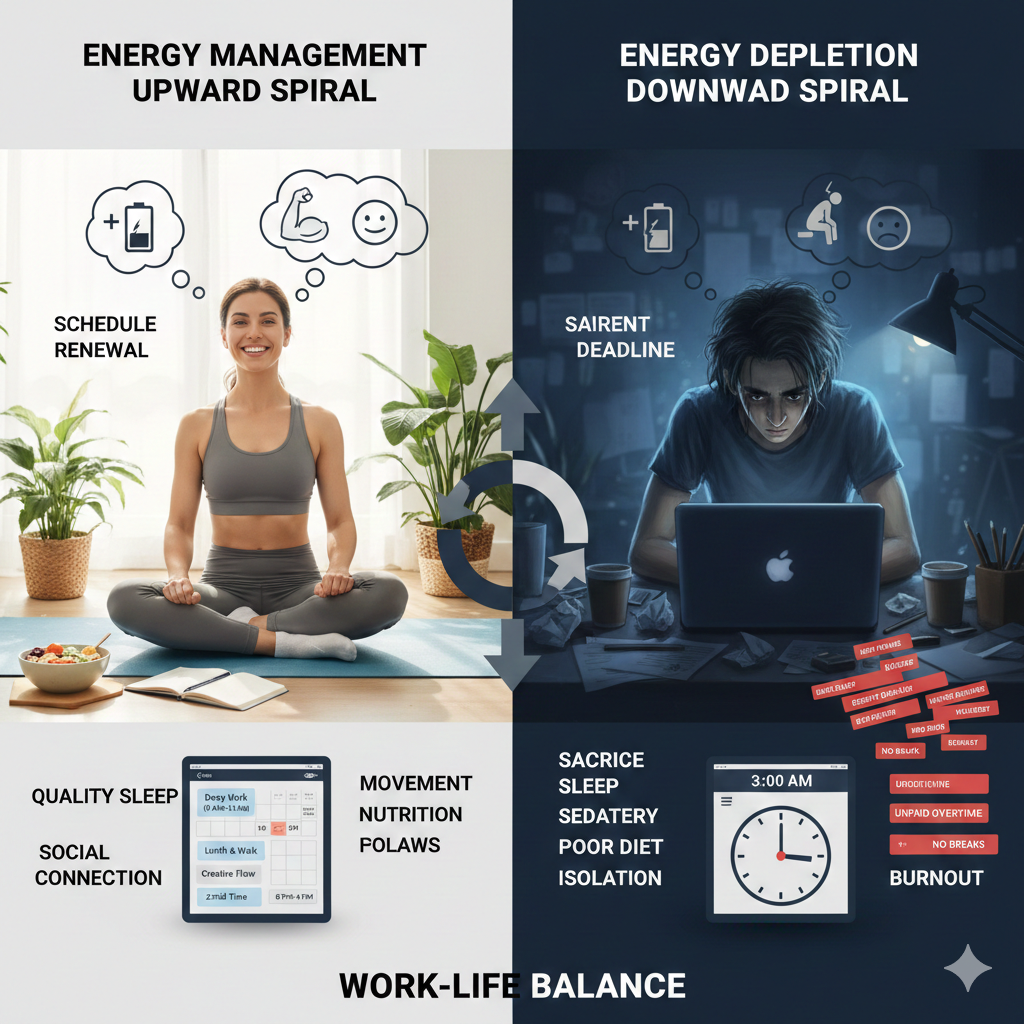
Effective work-life balance recognizes that time management alone is insufficient—you also need energy management. Schedule demanding work during your peak energy hours, protect time for renewal activities restoring energy, take regular breaks preventing depletion, and monitor your energy levels adjusting your schedule when you’re consistently exhausted.
Energy management includes adequate sleep, regular movement, proper nutrition, social connection, and activities that energize rather than drain you. Sacrificing these for more work time creates downward spiral where decreasing energy reduces work quality and efficiency, requiring even more time for the same results.
Energy Optimization:
- Schedule demanding work during peak energy times
- Take regular breaks (try Pomodoro Technique)
- Protect adequate sleep (7-9 hours for most adults)
- Incorporate movement throughout your day
- Identify and limit energy-draining activities
- Build in renewal activities that restore energy
- Monitor energy levels and adjust accordingly
Energy Drains vs. Sources:
Identify what drains your energy (certain tasks, people, environments) and what restores it (movement, nature, creative activities, social connection for extroverts, solitude for introverts). Structure your days maximizing energy sources and minimizing drains when possible.
Rest as Productivity:
Reframe rest not as laziness but as essential for sustained high performance. Well-rested professionals accomplish more in focused hours than exhausted ones working longer with diminishing returns. Protecting rest supports work-life balance and career effectiveness simultaneously.
For wellness and energy management resources, visit: 👉 https://easynaukri4u.com/
7. Practice Single-Tasking and Full Presence

Multitasking—attempting to work while partially attending to personal life or being physically present with family while mentally at work—creates impression of balance while delivering neither effective work nor quality personal time. Work-life balance improves dramatically when you fully focus on current activity whether work or personal, giving complete attention rather than fractured partial presence.
Practice single-tasking: when working, focus exclusively on work with minimal distractions. When with family or engaged in personal activities, put away devices and be fully present. This approach makes both work and personal time more effective and satisfying than perpetual partial attention to both.
Full Presence Practices:
- Put away all devices during meals and family time
- Close all unrelated tabs and applications during work tasks
- Use time blocking for focused work sessions
- Be mentally present, not just physically present
- Notice when attention wanders and redirect it
- Communicate to others when you need focused time
- Practice mindfulness strengthening attention
Quality Over Quantity:
Two hours of fully present family time provides more connection than six hours of distracted physical presence. Three hours of focused work accomplishes more than eight hours of constantly interrupted multitasking. Work-life balance isn’t just about time allocation but quality of attention.
Mindfulness Integration:
Brief mindfulness practices—even 5-10 minutes daily—strengthen your ability to maintain present focus and notice when attention drifts. This skill improves both work effectiveness and personal relationship quality.
8. Regularly Assess and Adjust Your Balance
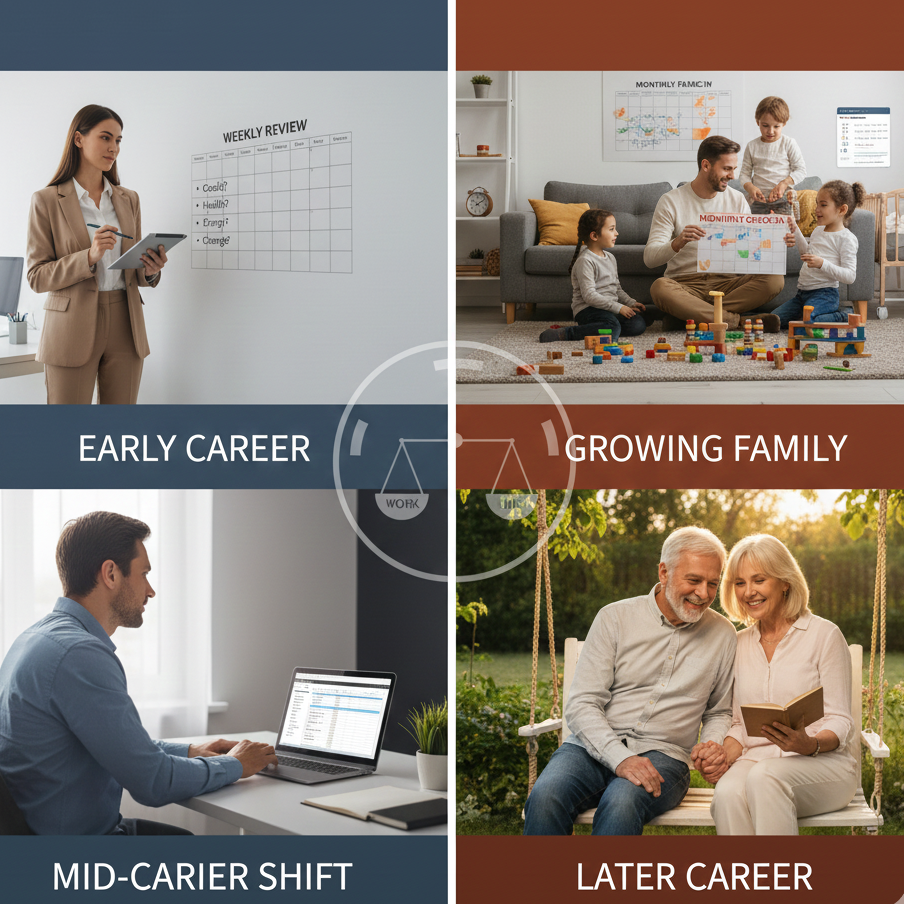
Work-life balance requires ongoing assessment and adjustment rather than one-time achievement. Schedule regular reviews (weekly, monthly, quarterly) evaluating whether your current balance aligns with your values and goals. Ask yourself: Am I spending time on what truly matters? Am I sacrificing health or relationships for work? Do I have adequate energy and renewal time? What needs to change?
Life circumstances, career phases, and personal priorities shift over time, requiring balance adjustments. The balance supporting you when single and early-career differs from what you need with family responsibilities or later-career stages. Regular assessment ensures your approach evolves with changing circumstances.
Assessment Questions:
- Am I satisfied with time allocation across key life areas?
- Do I have energy for what matters most?
- Are my current priorities aligned with my values?
- What areas of life am I neglecting?
- What’s working well that I should maintain?
- What specific changes would improve my balance?
- Am I maintaining boundaries or letting them erode?
Adjustment Process:
Based on assessment, identify 1-3 specific changes to improve your work-life balance. Make these changes, observe results for 2-4 weeks, reassess, and adjust again. This iterative approach continuously improves balance rather than expecting perfect solutions immediately.
Seasonal Balance:
Recognize that balance fluctuates—some work periods are naturally more demanding while others allow more personal focus. As long as intense periods are temporary and followed by recovery, this variation is healthy. Problems arise when imbalance becomes chronic rather than episodic.
9. Invest in Relationships Deliberately
Maintaining meaningful relationships requires deliberate investment of time and energy that work-life balance must protect. Schedule regular quality time with partners, family, and friends rather than relegating relationships to whatever time remains after work. These connections provide essential support, joy, and meaning that work alone cannot deliver.
Relationships suffer from benign neglect when career demands consistently take priority. While loved ones may understand occasional work demands, chronic work prioritization damages relationships potentially irreparably. Protecting relationship time isn’t just about personal fulfillment—strong relationships actually support career resilience and success.
Relationship Investment:
- Schedule regular date nights or partner time
- Protect family meals or quality family time
- Maintain friendships through regular contact
- Be fully present during relationship time (no devices)
- Communicate about work demands affecting relationships
- Involve family in decisions about work-life trade-offs
- Express appreciation for loved ones’ support
- Make relationship time non-negotiable except for true emergencies
Communication About Work:
Talk with partners and family about your work demands, upcoming intense periods, and how you’ll protect relationship time. This communication builds understanding and shared planning rather than relationships feeling like competition with work.
Quality Moments:
When time is limited, focus on quality connection—meaningful conversations, shared activities, full presence—rather than just physical proximity. Even 20 minutes of genuine connection matters more than hours of distracted coexistence.
10. Develop Healthy Coping Mechanisms for Stress
Work stress is inevitable, but how you manage it significantly impacts work-life balance. Develop healthy stress management practices—exercise, meditation, hobbies, social support, therapy when needed—rather than unhealthy coping like excessive alcohol, overworking, or withdrawal from relationships. Healthy coping mechanisms reduce stress’s impact while supporting overall wellbeing.
Regular stress management practices prevent buildup leading to burnout or health problems. Don’t wait until you’re overwhelmed to address stress—build preventive practices into regular routines supporting resilience during challenging periods.
Healthy Stress Management:
- Regular exercise or physical activity
- Meditation or mindfulness practices
- Hobbies and creative outlets
- Social connection and support
- Professional therapy or counseling
- Adequate sleep and rest
- Time in nature
- Journaling or expressive writing
Stress Warning Signs:
Learn to recognize your stress signals—physical symptoms, emotional changes, sleep disruption, relationship irritability—and intervene early rather than waiting until stress becomes overwhelming. Early intervention is more effective and requires less recovery time.
Workplace Stress Reduction:
Beyond personal coping, address workplace stress sources when possible. Have conversations about unrealistic workloads, request resources or support, and advocate for sustainable work expectations. Sometimes work-life balance requires changing work circumstances, not just coping better with unsustainable situations.
For stress management and wellness programs, explore: 👉 https://easynaukri4u.com/
11. Learn to Delegate and Ask for Help
Many work-life balance problems stem from trying to do everything yourself at work and home. Learning to delegate work tasks, share household responsibilities, and ask for help when overwhelmed creates capacity for better balance. Perfectionism and belief that you must handle everything personally creates unnecessary pressure undermining balance.
At work, delegate tasks that others can handle, allowing you to focus on work requiring your unique expertise. At home, share responsibilities with partners, hire help for tasks you can afford to outsource, and involve children in age-appropriate household contributions. Asking for help isn’t weakness—it’s smart resource management.
Delegation Strategies:
- Identify tasks others can handle adequately
- Delegate with clear expectations and authority
- Accept that others may do things differently, not necessarily worse
- Share household responsibilities equitably
- Outsource tasks when economically sensible
- Ask family and friends for help when needed
- Let go of perfectionism about delegated tasks
Work Delegation:
Many professionals resist delegating believing only they can do things properly. However, delegation develops others while freeing your time for highest-value work and better work-life balance. Focus on work that genuinely requires your expertise, delegating everything else.
Home Responsibilities:
Explicitly discuss and divide household responsibilities with partners rather than defaulting to traditional patterns or one person carrying disproportionate burden. Consider outsourcing cleaning, meal prep, or other tasks if financially feasible, freeing time for what truly matters.
12. Take Real Vacations and Disconnected Time
Meaningful work-life balance requires periods of complete disconnection from work for genuine rest and renewal. Take your allocated vacation time—research shows unused vacation correlates with higher burnout and lower job performance. During vacations, truly disconnect from work email and communications except for genuine emergencies.
Many professionals take “vacations” while constantly checking email and handling work issues, preventing the mental recovery that vacations provide. Set clear coverage plans, communicate limited availability, and trust colleagues to manage during your absence. You’ll return more energized and effective than if you never truly disconnected.
Effective Vacation Practices:
- Use your allocated vacation time fully
- Plan coverage and transitions before leaving
- Set auto-responders with alternative contacts
- Delete work email from phone or use airplane mode
- Establish true emergency criteria (very few things qualify)
- Take varied vacation types (active adventures, restful retreats, family time)
- Don’t schedule return immediately before major deadlines
Micro-Vacations:
In addition to longer vacations, build mini-breaks into your routine—long weekends, mental health days, or simply leaving work at reasonable hours with evenings fully disconnected. These smaller recovery periods maintain work-life balance between major vacations.
Return Strategies:
Build buffer time upon return rather than scheduling important meetings or deadlines immediately. This allows catching up and readjusting without overwhelming stress destroying vacation benefits.
13. Align Your Career With Your Values
Long-term work-life balance is easier when your career fundamentally aligns with your values and allows lifestyle you want. If your job chronically requires sacrifices inconsistent with your values or desired life, achieving sustainable balance may require career changes—different role, company, or field better supporting your priorities.
Assess whether your current career path supports the life you want long-term. If misalignment exists, consider what changes might improve fit—negotiating flexibility in current role, changing employers, pursuing different opportunities, or redefining career success on your own terms rather than external expectations.
Values Assessment:
- What matters most to you in life?
- Does your current career support or hinder those values?
- What career allows the lifestyle you want?
- Are you pursuing career success as you define it or others define it?
- What trade-offs are you willing and unwilling to make?
Career Alignment Actions:
If your job fundamentally conflicts with your values and desired balance, explore options: negotiate flexibility with current employer, seek roles at companies with cultures supporting balance, consider career changes allowing desired lifestyle, or redefine career progression on your own terms.
Redefining Success:
Sometimes work-life balance requires redefining career success from maximum advancement or earnings to sustainable career supporting overall life satisfaction. This isn’t settling—it’s choosing alignment between career and complete life rather than career dominating everything else.
14. Model and Advocate for Work-Life Balance
Creating sustainable work-life balance often requires changing workplace cultures, not just individual behavior. Model healthy boundaries and balance in your own behavior, talk openly about balance importance, support colleagues’ boundary-setting, and advocate for organizational policies supporting balance. Leaders particularly influence organizational culture through their example.
When leaders consistently email late at night, skip vacations, or brag about extreme hours, they create cultures where balance seems impossible despite stated organizational support. Conversely, leaders who model boundaries, take vacations, and explicitly support balance give permission for others to do likewise.
Modeling Balance:
- Maintain and communicate your boundaries
- Take your vacation time visibly
- Avoid sending emails outside work hours (or use scheduled send)
- Talk positively about personal time and commitments
- Support colleagues’ boundary-setting
- Refuse to reward presenteeism over productivity
- Address toxic overwork cultures directly
Advocacy Actions:
- Propose or support flexible work policies
- Address unrealistic workload expectations
- Advocate for adequate staffing and resources
- Challenge always-on culture norms
- Support colleagues requesting accommodations
- Speak up when policies contradict balance rhetoric
- Participate in wellness initiatives
Cultural Change:
Individual work-life balance is easier in supportive cultures. Collective advocacy can shift organizational norms making balance achievable for everyone rather than constant individual struggle against toxic cultures.
For workplace wellness advocacy resources, visit: 👉 https://easynaukri4u.com/
Overcoming Common Work-Life Balance Obstacles
Dealing With Guilt
Many professionals feel guilty prioritizing personal time, fearing they’re being lazy, letting teams down, or sacrificing career advancement. This guilt undermines work-life balance even when you’ve set boundaries. Recognize that sustainable careers require rest and renewal, that you’re more effective when balanced than when perpetually exhausted, and that modeling balance helps others while protecting your wellbeing.
Reframe self-care and boundaries not as selfish indulgence but as essential professional practice enabling sustained high performance. You cannot give from empty cup—protecting your wellbeing ultimately serves everyone better than burning out.
Addressing Organizational Resistance
Some organizations explicitly or implicitly resist work-life balance through cultures rewarding extreme hours, insufficient staffing creating impossible workloads, or leadership dismissing balance concerns. In these situations, individual strategies help but may not fully solve systemic problems.
Options include negotiating boundaries within constraints, documenting impacts of unsustainable expectations, collective advocacy for changes, or ultimately changing employers if organizations fundamentally don’t support balance. Sometimes work-life balance requires voting with your feet toward healthier environments.
Managing Financial Pressures
Financial obligations sometimes seem to require work hours or career choices incompatible with work-life balance. While real financial constraints exist, examine whether all perceived necessities truly are—could lifestyle adjustments enable better balance? Are you pursuing others’ definitions of success rather than your own?
Sometimes achieving work-life balance requires accepting less income for better quality of life. Other times, it means finding more sustainable high-earning paths rather than assuming sacrifice is necessary for financial success.
Handling Career Stage Challenges
Work-life balance looks different across career stages. Early career may require more intensive work building foundations and capabilities. Mid-career often involves peak family responsibilities alongside career demands. Later career may allow more control and flexibility. Recognize that balance varies across life stages while avoiding assumption that some stages require complete imbalance.
Industry-Specific Balance Considerations
Healthcare and High-Stakes Professions
Professions involving life-or-death decisions, patient care, or crisis response face unique work-life balance challenges given stakes involved and unpredictable demands. However, even these fields increasingly recognize that exhausted professionals make mistakes and that sustainable staffing and reasonable schedules improve both worker wellbeing and patient/client outcomes.
Advocate for systemic changes addressing root causes of imbalance—adequate staffing, reasonable shift lengths, proper coverage—rather than accepting that imbalance is inevitable in these fields.
Technology and Always-On Industries
Technology and startup cultures often glorify extreme hours and constant availability, creating particular work-life balance challenges. However, research increasingly shows that sustainable work practices improve both innovation and productivity compared to unsustainable grinding.
Seek companies explicitly supporting balance, set firm boundaries even in demanding cultures, and recognize that you may need to change employers to find healthy environments.
Creative and Passion-Driven Work
When work aligns with passion, boundaries between work and life can blur as work feels fulfilling rather than purely obligatory. However, even passionate work requires work-life balance preventing burnout and maintaining other important life aspects.
Set boundaries protecting relationships and health even when work feels intrinsically rewarding. Passion doesn’t eliminate the need for rest, connection, and life beyond work.
Conclusion: Creating Your Sustainable Balance
Achieving meaningful work-life balance in 2026 requires intentional boundary-setting, regular assessment and adjustment, alignment between career and values, healthy coping strategies, and often cultural advocacy for sustainable work practices. The fourteen strategies outlined in this guide—from establishing non-negotiable personal time and practicing ruthless prioritization to modeling balance and managing energy deliberately—provide comprehensive framework for creating balance supporting both professional success and personal fulfillment.
Remember that work-life balance isn’t destination you arrive at permanently but rather ongoing practice requiring continuous attention and adjustment. Perfect balance rarely exists—some periods naturally emphasize work while others allow more personal focus. The goal is overall sustainability across time, protecting what matters most, and making intentional choices aligned with your values rather than defaulting to work consuming everything.
Start improving your work-life balance today by selecting 2-3 strategies from this guide to implement immediately. Whether that means establishing specific work hour boundaries, scheduling non-negotiable personal time, creating shutdown rituals, or having honest conversations about workload sustainability, small changes create momentum toward healthier balance.
Your wellbeing, relationships, health, and ultimately your long-term career success depend on achieving sustainable work-life balance. Chronic imbalance leads to burnout, health problems, damaged relationships, and decreased work effectiveness—outcomes serving neither professional nor personal goals. Conversely, sustainable balance supports vitality, creativity, strong relationships, and career longevity.
Take action now by examining your current balance honestly, identifying one change that would meaningfully improve your situation, and implementing that change starting today. Your future self—healthier, more fulfilled, with stronger relationships and sustainable career—will thank you for the investment in creating work-life balance that supports your complete life.
For comprehensive wellness resources, career guidance, and work-life balance support helping you create sustainable professional success alongside personal fulfillment, visit: 👉 https://easynaukri4u.com/
The career and life you want aren’t mutually exclusive—sustainable work-life balance allows you to excel professionally while maintaining health, relationships, and personal fulfillment. Start building that balance today through intentional choices, firm boundaries, and commitment to sustainable practices supporting your complete wellbeing. Your career is marathon, not sprint—pace yourself accordingly.